—
Preseason Magazines
—
August 17th
***Associated Press preseason Top 25 released*** – Ohio State No. 1; four Big 12 teams ranked
… With Texas Tech being voted 12th, the Red Raiders have earned their highest preseason AP ranking since 1977 … BYU ranking of 14th is its second highest in a preseason poll in program history … Houston received its highest preseason ranking from the AP since being voted 15th prior to the 2016 season … Five of the Big 12’s 13 Power Four non-conference opponents were ranked in Monday’s preseason poll …
From ESPN … Ohio State and Oregon were 1-2 in The Associated Press Top 25 released Monday, giving the Big Ten Conference the top two teams in the preseason rankings for the first time in 65 years and just the second time ever.
The Buckeyes received 40 first-place votes and Oregon received 14 in voting by 69 media members who cover college football for the AP and other news organizations.
Ohio State will go into a season ranked No. 1 for the ninth time, and first since 2015. The Buckeyes are now tied with Alabama for second-most preseason No. 1 rankings behind Oklahoma’s 10.
Oregon has its highest preseason ranking in program history after having opened No. 3 four times.
Georgia, Notre Dame and Texas round out the top five.
“I love the polls for college football fans, for the excitement, for the marquee matchups, for all those things,” Texas coach Steve Sarkisian said. “But the polls, internally, they just don’t matter. They’re really irrelevant. I think we’ve gotten to a point now as a team to understand that what matters is how we play each and every Saturday.”
Defending national champion Indiana starts at No. 6 and is followed by Miami, Texas A&M, Ole Miss and Oklahoma.
Notre Dame received six first-place votes, Indiana got eight and Miami one.
This is the first year a conference has held down the top two spots in the preseason poll since Oklahoma and Nebraska of the Big Eight were 1-2 in 1987.
| School | Pts. | ’25 Rec. |
|---|---|---|
| 1. Ohio State (40) | 1,672 | 12-2 |
| 2. Oregon (14) | 1,597 | 13-2 |
| 3. Georgia | 1,513 | 12-2 |
| 4. Notre Dame (6) | 1,510 | 10-2 |
| 5. Texas | 1,483 | 10-3 |
| 6. Indiana (8) | 1,440 | 16-0 |
| 7. Miami (1) | 1,379 | 13-3 |
| 8. Texas A&M | 1,131 | 11-2 |
| 9. Ole Miss | 1,102 | 13-2 |
| 10. Oklahoma | 1,047 | 10-3 |
| 11. LSU | 988 | 7-6 |
| 12. Texas Tech | 983 | 12-2 |
| 13. Alabama | 904 | 11-4 |
| 14. BYU | 839 | 12-2 |
| 14. Southern Cal | 839 | 9-4 |
| 16. Michigan | 718 | 9-4 |
| 17. Washington | 501 | 9-4 |
| 18. Penn State | 482 | 7-6 |
| 19. SMU | 434 | 9-4 |
| 20. Tennessee | 394 | 8-5 |
| 21. Utah | 304 | 11-2 |
| 22. Iowa | 260 | 9-4 |
| 23. Houston | 252 | 10-3 |
| 24. Louisville | 194 | 9-4 |
| 25. Missouri | 117 | 8 |
Others receiving votes … Others receiving votes: Clemson 112, Florida 51, Boise State 43, Arizona 32, TCU 11, South Carolina 10, Navy 10, Illinois 9, Vanderbilt 8, Oklahoma State 8, Pittsburgh 7, Virginia Tech 6, Minnesota 5, UNLV 4, Louisiana 4, New Mexico 4, Georgia Tech 4, James Madison 3, Auburn 3, Memphis 2, California 2, Western Michigan 1, Tulane 1, Liberty 1, Virginia 1
–
—–
August 12th
CBS 1-138 preseason rankings – Three Big 12 teams in Top 25; CU in at No. 65
… According to CBS, CU is the 14th-best team in the Big 12. As CU doesn’t play Iowa State or West Virginia this season, and as CBS has both Georgia Tech and Northwestern ranked above the Buffs, the projections from CBS Sports for CU would be a 1-11, 0-9 record for the 2026 season …
From CBS Sports … The season of rankings has arrived in college football, and you may see various top 16s and top 25s elsewhere, CBS Sports prefers to take a wider — nay, complete — view of this awesome sport. The CBS Sports 138 is a comprehensive ranking of every FBS team, which has grown by two this year with the additions of North Dakota State and Sacramento State.
Experts from CBS Sports and 247Sports will fill out ballots each week during the season, reacting to the weekend’s results. Of course, that process still requires a starting point, which is achieved through CBS Sports’ official preseason rankings for the 2026 campaign.
Perhaps the most interesting storyline to emerge from the initial voting process was the wide range of teams that received first-place votes in our balloting: No. 1 Ohio State, No. 2 Oregon, No. 3 Notre Dame, No. 4 Texas and No. 7 Miami (FL).
Complicating matters even further? Two tried-and-true College Football Playoff contenders, No. 5 Georgia and No. 6 Indiana, received zero first-place votes but clearly have enough support to be among those top teams. With so many different teams getting first-place votes, no one has a true hold on the ranking, which could set up for some excellent shifts and debates once the season rolls through Week 1 and beyond. (Perhaps no team is truly “No. 1” yet, which is fair, as that title must be earned on the field.)
Of course, the rankings extend far beyond the top 10 and even the top 25, and the year-to-year changes from the 2025 final rankings to the 2026 preseason rankings reflect a shift in attitudes following player and coach movement.
From the Big 12 …
- No. 8 – Texas Tech
- No. 16 – BYU
- No. 24 – Utah
- No. 26 – Houston
- No. 30 – Arizona
- No. 31 – TCU
- No. 34 – Kansas State
- No. 41 – Arizona State
- No. 44 – Oklahoma State
- No. 47 – Georgia Tech
- No. 48 – Northwestern
- No. 53 – Baylor
- No. 54 – Cincinnati
- No. 56 – Kansas
- No. 59 – UCF
- No. 65 – Colorado
- No. 67 – West Virginia
- No. 69 – Iowa State
- No. 101 – Colorado State
–
—–
August 4th
USA Today Preseason Coaches Poll released: Ohio State No. 1; Four Big 12 teams ranked
From USA Today … The 2026 football season is almost here.
On Tuesday, Aug. 4, USA TODAY Sports released its preseason US LBM Coaches Poll. Not shockingly, Ohio State took the top spot in the first poll of the 2026 college football season.
A college football preseason poll means one thing for high school football: The season on the prep side is also quickly approaching.
To be ranked in the Coaches Poll, teams had to assemble a roster capable of having a shot to win a national championship in 2026. Roster building, as always, begins in high school recruiting.
Preseason Coaches Poll
- Ohio State (38 first place votes)
- Oregon (6)
- Georgia (7)
- Texas (2)
- Notre Dame (5)
- Indiana (14)
- Miami
- Texas A&M
- Oklahoma
- Ole Miss
- Alabama
- Texas Tech
- LSU
- USC
- BYU
- Michigan
- Penn State
- Tennessee
- Washington
- SMU
- Utah
- Iowa
- Clemson
- Houston
- Missouri
Others Receiving Votes
Louisville 153; Florida 147; TCU 63; Illinois 62; South Carolina 50; Arizona 50; Virginia 40; Vanderbilt 37; Auburn 29; Georgia Tech 26; Boise State 24; Oklahoma State 22; UNLV 17; North Carolina State 13; Florida State 13; Virginia Tech 12; Nebraska 12; Memphis 9; Arizona State 8; James Madison 6; Duke 6; Pittsburgh 4; New Mexico 4; Western Michigan 3; Navy 3; San Diego State 2; Kansas State 1; Jacksonville State 1; Hawaii 1; California 1
List Of Voters
The US LBM Board of Coaches for the 2026 season: Tim Albin, Charlotte; Blake Anderson, Southern Mississippi; Dave Aranda, Baylor; David Braun, Northwestern; Jeff Brohm, Louisville; Fran Brown, Syracuse; Neal Brown, North Texas; Troy Calhoun, Air Force; Jamey Chadwell, Liberty; Curt Cignetti, Indiana; Sonny Cumbie, Louisiana Tech; Spencer Danielson, Boise State; Ryan Day, Ohio State; Kalen DeBoer, Alabama; Manny Diaz, Duke; Jake Dickert, Wake Forest; Eliah Drinkwitz, Missouri; Sonny Dykes, TCU; Jason Eck, New Mexico; Mike Elko, Texas A&M; Tony Elliott, Virginia; Matt Entz, Fresno State; Jedd Fisch, Washington; James Franklin, Virginia Tech; Willie Fritz, Houston; Scott Frost, Central Florida; Tony Gibson, Marshall; Alex Golesh, Auburn; Will Hall, Tulane; Blake Harrell, East Carolina; John Hauser, Ohio; Clay Helton, Georgia Southern; Tyson Helton, Western Kentucky; Charles Huff, Memphis; Butch Jones, Arkansas State; KC Keeler, Temple; Charles Kelly, Jacksonville State; Brent Key, Georgia Tech; Zach Kittley, Florida Atlantic; Collin Klein, Kansas State; Tre Lamb, Tulsa; Rhett Lashlee, SMU; Clark Lea, Vanderbilt; Lance Leipold, Kansas; Pete Lembo, Buffalo; Sean Lewis, San Diego State; Dowell Loggains, Appalachian State; Joey McGuire, Texas Tech; Jeff Monken, Army; Kirby Moore, Washington State; Eric Morris, Oklahoma State; Dan Mullen, UNLV; Billy Napier, James Madison; Pat Narduzzi, Pittsburgh; Brian Newberry, Navy; Ken Niumatalolo, San Jose State; Barry Odom, Purdue; Tim Polasek, North Dakota State; Tavita Pritchard, Stanford; Ricky Rahne, Old Dominion; Matt Rhule, Nebraska; Rich Rodriguez, West Virginia; Morgan Scalley, Utah; JaMarcus Shephard, Oregon State; Kirby Smart, Georgia; Will Stein, Kentucky; Jon Sumrall, Florida; Lance Taylor, Western Michigan; Jeff Traylor, Texas-San Antonio; Scotty Walden, Texas-El Paso; Kyle Whittingham, Michigan; Casey Woods, Missouri State.
–
—–
August 3rd
Julian Lewis becomes the 10th Buff to earn Maxwell Award watch list nomination
From CUBuffs.com … Colorado quarterback Julian Lewis was named to the watch list for the 90th Maxwell Award, the Maxwell Football Club announced Monday, placing the second-year Buffalo among 81 candidates for the honor presented annually to the outstanding player in college football.
Lewis is one of 15 players from the Big 12 on the list.
A five-star prospect from Carrollton, Ga., Lewis played in four games in 2025 and started two, completing 52-of-94 passes for 589 yards with four touchdowns and no interceptions. He was the ninth true freshman to start at quarterback for the Buffaloes, a list dating back to 1959.
His first career start came at West Virginia, where he was 22-of-35 for 299 yards with two touchdowns and no interceptions, a performance that earned him PFF Big 12 Quarterback of the Week honors. That total is the second-most passing yards by a CU true freshman in a first start, behind only Koy Detmer, who threw for 418 yards in a 24-24 tie with Oklahoma in 1992. Lewis and Detmer are the only two of the nine to throw a pair of touchdown passes in a debut start.
Lewis is the 10th Buffalo to earn Maxwell Award consideration. Three have reached the final three: Rashaan Salaam was the runner-up in 1994, Eric Bieniemy finished third in 1990 and Travis Hunter was a finalist in 2024. Laviska Shenault (2018) and Shedeur Sanders (2024) both advanced to the semifinal round.
Semifinalists for the 2026 Maxwell Award will be announced Nov. 10, with three finalists named Nov. 24. The winner will be revealed Dec. 10 as part of the ESPN Home Depot College Football Awards Show, with the formal presentation March 13, 2027, at the Coca-Cola Roxy Theater in Atlanta.
… Continue reading story here …
–
—
ESPN: 31 teams could make the College Football Playoff (including six from Big 12)
From ESPN … According to ESPN Research, there are 28 teams with at least a 10% chance to reach the College Football Playoff this season. One notable difference in the 12-team format this fall is that each Power 4 conference champion is guaranteed a spot in the field — which means that any team with a shot at winning the Big Ten, SEC, Big 12 and ACC is a legitimate CFP contender. Notre Dame is also guaranteed an automatic bid if it finishes in the top 12 on Selection Day.
Beyond the wealthy blue bloods, though, how deep does the pool of playoff candidates really run? As leaders of the CFP continue to discuss how large the field should be in future iterations of the playoff, how many teams can legitimately compete for the national title?
“I think there’s at least 10,” Alabama coach Kalen DeBoer said. “But the trick is, can you get those 10 teams into the 12-team field? That’s the trick because there are some automatic qualifiers.”
“Probably year in and year out, I guess 15, somewhere around there,” Ohio State coach Ryan Day said. “I think when you look at last year, some of the guys who were right on the fence of getting in probably could have made a deep run. So my guess would be right around there, but it probably depends on the year.”
“Is it 14 or so, give or take?” Texas coach Steve Sarkisian said.
“You may think I’m crazy, but I think 15 to 20,” South Carolina coach Shane Beamer said.
“Maybe 10, 15,” Oregon coach Dan Lanning said. “But are they healthy? There were some teams last year you might argue didn’t have great seasons, but maybe they could have if other things would have happened.”
Here are 31 teams — that’s right, 31 — that the CFP selection committee might consider at some point this fall. From favorites to long shots, the following list considers information from ESPN Analytics along with historical knowledge of what the committee likes (and doesn’t) about the schedules each team will present as its résumé. DraftKings odds to win the national title were recorded July 31 and are subject to change.
From the Big 12 …
13. BYU Cougars
Last year’s record: 12-2
Overall CFP record: N/A
ESPN Analytics: Make playoff: 25.7% | Win national title: .7%
DraftKings odds to win the national title: +9000
Agree or disagree with ESPN Analytics: Disagree. With a Texas Tech-BYU rematch a strong possibility for this year’s Big 12 title game, the Cougars’ chances of making the playoff field should be higher. The Big 12 champion is guaranteed a spot in the playoff, and while the computers still like Texas Tech to win the league (45.9%), no other team besides BYU has more than a 16% chance.
Toughest test: Oct. 17 vs. Notre Dame. The Cougars will have home field advantage, but this will likely be BYU’s highest-ranked regular-season opponent.
What the committee will like: A Big 12 title. If BYU can’t beat the Irish at home, it can guarantee itself a spot in the CFP with a conference title. BYU was excluded last year because it lost twice to Texas Tech in convincing fashion. This year, the Cougars don’t face the Red Raiders during the regular season. One redemption shot could be all they need to earn their first CFP bid.
What the committee won’t like: More lopsided losses to CFP contenders. Texas Tech outscored BYU 63-14 in two games last year. That’s why the Cougars didn’t earn a spot with the Red Raiders, even though they finished as the league runner-up. BYU will have tough games against Arizona, at TCU, against Notre Dame and at Utah. The committee isn’t going to keep BYU out because of a close road loss to Utah, and it could still survive if it loses close to Notre Dame and finishes as a two-loss Big 12 runner-up. If BYU is going to stumble, though, it can’t be by a large margin multiple times.
—
14. Texas Tech Red Raiders
Last year’s record: 12-2
Overall CFP record: 0-1
ESPN Analytics: Make playoff: 57.9% | Win national title: 3.7%
DraftKings odds to win the national title: +2200
Agree or disagree with ESPN Analytics: Mostly agree. Like BYU, Texas Tech is a front-runner to play in the Big 12 title game, which gives it at least a 50% chance to reach the CFP. The roster is still loaded even without quarterback Brendan Sorsby, but the Red Raiders need to keep their new starter, Will Hammond, healthy to make a playoff run.
Toughest test: Oct. 24 at Cincinnati. ESPN’s FPI gives Texas Tech at least an 80% chance to win each of its games, but this one is on the road against Sorsby’s former team. Even though Sorsby has moved on, this one could still be a trap game.
What the committee will like: A 2-0 record against the state of Arizona. Last year, ASU pulled off one of the season’s biggest upsets with its 26-22 win against Texas Tech, the Red Raiders’ lone loss of the season. This year, Texas Tech hosts ASU on Oct. 17 and Arizona on Halloween. Expectations are higher for the Wildcats, who could be a surprise contender for the Big 12, but they could both be tricky opponents with a trip to Cincy sandwiched in between.
What the committee won’t like: No BYU, Utah or K-State on the schedule. Texas Tech will miss what should be the league’s highest-ranked opponents. Its schedule is ranked No. 71 in the FBS, according to ESPN Analytics. The nonconference lineup includes Abilene Christian, Oregon State and Sam Houston. If Texas Tech doesn’t win the Big 12, its weaker schedule could be an issue for some committee members unless the Red Raiders are otherwise so dominant they look the part of a playoff team regardless.
—
20. Arizona Wildcats
Last year’s record: 9-4
Overall CFP record: 0-0
ESPN Analytics: Make playoff: 7.8% | Win national title: 0.1%
DraftKings odds to win the national title: +25000
Agree or disagree with ESPN Analytics: Disagree. This is a super low percentage considering Arizona has a real chance to contend for the Big 12 title. It could also sneak in with an at-large bid as the league’s runner-up. Texas Tech and BYU are the front-runners to play for the title, but Arizona will face them both during the regular season.
Toughest test: Oct. 31 at Texas Tech. Halloween in Lubbock? ESPN’s FPI gives Texas Tech an 86.8% chance to win. If Arizona doesn’t beat BYU on the road in Week 2, a second league loss would be devastating for hopes of playing in the Big 12 championship game.
What the committee will like: A winning record on the road. Arizona’s playoff chances will most likely be decided on the road, where the Wildcats will face BYU, West Virginia, Texas Tech and Kansas State. They have to at least go 2-2, but wins at WVU and K-State aren’t gimmes. Morgantown is a notoriously tough place to play, and K-State could be a CFP top-25 team. If Arizona can beat both of those opponents and at least split with BYU and Texas Tech, the selection committee would consider Arizona for a spot. The chances would increase significantly if one of those road wins came against the eventual Big 12 champ, or if Arizona was able to avenge a regular-season road loss against the same team in the Big 12 title game.
What the committee won’t like: Three losses before November. That’s what happened to Arizona last year (at Iowa State, vs. BYU, at Houston). With trips to both BYU and Texas Tech in the first half the season before the rankings come out, Arizona’s best chances to impress the committee will happen before they even start to meet. And if they can’t capitalize on them, Arizona will be an afterthought in the playoff race and the Big 12 race. If Arizona has two losses before November, it’s not impossible for the Wildcats to earn a CFP bid, but they’d likely do it as the Big 12 champion or hope the committee ranks multiple teams in the back half of their schedule to help compensate for it.
—
22. Houston Cougars
Last year’s record: 10-3
Overall CFP record: N/A
ESPN Analytics: Make playoff: 7.9% | Win national title: 0.1%
DraftKings odds to win the national title: +20000
Agree or disagree with ESPN Analytics: Disagree. The computers give Houston the 37th-best chance to reach the CFP, and that is too low, considering how wide open the Big 12 race could be. Houston also has a bulk of experience returning from last year’s 10-win team.
Toughest test: Sept. 18 at Texas Tech. An early road loss to a CFP contender on a Friday night won’t keep Houston out of the playoff, but it will be an indicator of how seriously to take the Cougars moving forward.
What the committee will like: At least a 2-1 record against Texas Tech, Kansas State and Utah. All three of those games are on the road, and ESPN’s FPI gives Houston less than a 50% chance to win each game. If Houston can pull off at least two wins, though, it would give the Cougars the head-to-head advantage in the committee’s rankings and increase Houston’s chances of reaching the Big 12 title game. It would also give the Cougars a little margin for error on the backstretch. With a 2-1 record, it’s possible Houston could earn a rematch against the team it lost to in the Big 12 title game. Houston would lock up a CFP bid as the Big 12 champ, but also earn a higher seed because of the eventual redemption win and head-to-head result.
What the committee won’t like: A November upset. The weakest part of Houston’s schedule is the final four weeks, when the committee is paying the closest attention and the rankings begin. With games against Cincinnati, Colorado, West Virginia and Baylor, it’s possible Houston goes the entire month without a statement win. The only thing worse than that is a bad loss. There’s no good time to lose, but CFP history says that it has been easier to overcome if it happens earlier in the season. With back-to-back road trips to Colorado and West Virginia, Houston needs to avoid a trap game — especially if it can’t survive earlier road trips to Texas Tech, K-State and Utah. ESPN’s FPI gives Colorado a 50.7% chance to win.
—
24. Utah Utes
Last year’s record: 11-2
Overall CFP record: N/A
ESPN Analytics: Make playoff: 11.1% | Win national title: 0.2%
DraftKings odds to win the national title: +10000
Agree or disagree with ESPN Analytics: Somewhat disagree. The computers give Utah the 30th-best chance to reach the playoff, which feels low, considering they should be one of the top four teams in the Big 12. There’s something to prove, though, in Year 1 under coach Morgan Scalley, especially with so many players gone from last year’s 11-win team.
Toughest test: Nov. 7 vs. BYU. ESPN’s FPI gives BYU a 58.7% chance to win. Unless Houston makes a move, this will likely be the highest-ranked opponent Utah faces during the regular season.
What the committee will like: A strong finish. There’s no way around it. Utah needs a November to remember, and right now, ESPN’s FPI gives the Utes less than a 50% chance to beat BYU, Arizona and TCU. Barring a strange season, that would likely eliminate Utah from the Big 12 title game and, in turn, knock the Utes out of the CFP race as a three-loss team without a statement win. Even if Utah loses at home to BYU, though, and can win three games on the road against Cincinnati, Arizona and TCU, the selection committee might still consider the Utes as a two-loss Big 12 runner-up. It would depend on how those losses unfolded, how good Utah looked in those road wins and if those opponents were ranked by the committee.
What the committee won’t like: A Week 2 loss to Arkansas. Utah’s nonconference schedule also includes Idaho and Utah State. It’s not like a win against Arkansas will move the needle much in the committee meeting room, but a loss to a lower-tier SEC team with a first-year head coach won’t help. It’s easier to overcome a bad loss if it happens early, but it also puts more pressure on Utah to finish strong, and the toughest part of the schedule is the second half of the season. Three of its last five games are on the road (Cincinnati, Arizona and TCU), with the Nov. 7 home game against BYU right after the first CFP ranking is revealed Nov. 3. If Utah doesn’t win the Big 12, and loses to an Arkansas team that shows only moderate improvement from last year’s 2-10 finish, the committee will be comparing the Utes with other contenders that have better nonconference wins.
—
27. TCU Horned Frogs
Last year’s record: 9-4
Overall CFP record: 1-1
ESPN Analytics: Make playoff: 6.9% | Win national title: 0.1%
DraftKings odds to win the national title: +25000
Agree or disagree with ESPN Analytics: Agree. These numbers give TCU the 39th-best chance to reach the CFP, and that is in the same ballpark because the Horned Frogs are not a front-runner to win the Big 12. That means TCU’s best shot will likely be as an at-large bid, and with one of the toughest schedules in the league, it will be difficult.
Toughest test: Nov. 26 at Texas Tech. It’s on Thanksgiving night, and ESPN’s FPI gives the Red Raiders an 87.4% chance to win at home. It doesn’t help TCU that this regular-season finale is the end of a gauntlet that also includes Arizona, K-State and Utah.
What the committee will like: Multiple wins against ranked Big 12 opponents. Every opponent TCU faces in November — Arizona, K-State, Utah and Texas Tech — has a chance to be a CFP top-25 team. They are all contenders for the Big 12 title game. Overall, the Horned Frogs have the No. 47 schedule in the country, and that won’t weigh them down much in the eyes of the committee, especially if those November teams live up to the hype. And it won’t sting as badly if a November loss is to the eventual Big 12 champs.
What the committee won’t like: A season-opening loss to North Carolina. Anything can happen in the season-opener in Dublin, Ireland, especially between two teams breaking in a new starting quarterback. But if TCU loses to UNC, and the Tar Heels have another sub-.500 season, that will be a stain on the Horned Frogs’ résumé through Selection Day. And it will only grow larger if TCU loses again — regardless of the opponent.
–
—–
July 30th
CBS Sports: Trap game for Northwestern is Ball State (not CU)
… Thankfully, there is only one month left before the season starts. National press totally out on CU this season …
From CBS Sports … Big Ten Media Days always produce championship promises, playoff predictions and optimism across the league. What coaches rarely discuss are the games capable of derailing those expectations. Every contender faces at least one dangerous spot this fall, often buried between rivalry showdowns, emotional road trips or nationally televised matchups.
Those are the weekends when preparation slips, focus wanders and an overlooked opponent becomes an unexpected headache. With the Big Ten chasing a fourth consecutive national championship, the margin for error is especially thin for teams with College Football Playoff aspirations.
Schedule placement matters almost as much as opponent quality, and several teams face difficult turnarounds this season. From hostile road environments to sleepy home games against rebuilding programs, here’s the biggest trap game awaiting every Big Ten team in 2026, beginning with the league’s top championship contenders and extending through programs fighting for bowl eligibility.
Northwestern
Biggest trap game: Ball State, Oct. 10
Colorado received consideration, but Northwestern has a rare Week 2 bye before hosting the Buffaloes. The more dangerous spot comes in October, when an uninspiring home game against Ball State is sandwiched between Big Ten matchups with Penn State and Michigan State. The Cardinals finished 4-8 last season under Mike Uremovich, but overhauled their roster with 34 transfers among 58 newcomers. Given Ball State’s struggles over the past decade, it would be easy for David Braun’s staff and players to devote more attention to the conference games surrounding this one.
–
—–
July 29th
Big Ten preseason media poll: Ohio State picked No. 1; Northwestern in at No. 14
From CBS Sports … The unofficial Big Ten preseason poll was released Monday, ahead of the league’s media days in Chicago. The top of the league is as crowded as ever entering the 2026 season, and the preseason media rankings — compiled by Cleveland.com — reflect a conference with legitimate national title aspirations.
Ohio State, Oregon and Indiana lead the way after the Buckeyes and Hoosiers — along with Michigan — combined to win the past three national championships, a run that has shifted the balance of power in college football and intensified the race to Indianapolis this fall.
The Buckeyes claimed the top spot in the preseason poll, but just barely. Ohio State received 15 first-place votes to Oregon’s 11, underscoring how little separation exists between the conference’s two most complete rosters. Indiana checked in at No. 3 and can no longer be viewed as a feel-good underdog after its breakthrough on the national stage.
That’s the backdrop for a season loaded with title contenders, intriguing coaching changes and several programs capable of reaching the College Football Playoff. The Big Ten’s traditional powers still command plenty of attention, but Oregon’s rapid rise under Dan Lanning and Indiana’s transformation have expanded the conference’s championship race.
Projected Big Ten standings
| Rank | Team (First-Place Votes) |
|---|---|
| 1 | Ohio State (15) |
| 2 | Oregon (11) |
| 3 | Indiana (5) |
| 4 | USC |
| 5 | Michigan |
| 6 | Penn State |
| 7 | Washington |
| 8 | Iowa |
| 9 | Illinois |
| 10 | Minnesota |
| 11 | Nebraska |
| 12 | Wisconsin |
| 13 | UCLA |
| 14 | Northwestern |
| 15 | Maryland |
| 16 | Michigan State |
| 17 | Rutgers |
| 18 | Purdue |
–
—–
July 27th
ESPN’s “100 Games That Explain College Football” – CU involved in five of those games
… The last one (below) is just for me. They will be talking about the finish to the 2025 FCS title game in Bozeman for years to come …
From ESPN … In a few more weeks, the 158th college football season will kick off. It will feature players on seven-digits-a-year contracts and coaches on eight digits a year. It will finish with a 12-team playoff amid a slate of 40-something bowls. It will feature conference games like West Virginia-Utah, UCF-Oklahoma State and USC-Rutgers but won’t feature Pitt-West Virginia, Oklahoma-Oklahoma State or USC-Notre Dame.
The games remain thrilling, and Saturdays remain immaculate. But it’s sometimes worthwhile to step back and ask, how the heck did we get here? So with games broken up into key categories — from change agents (like tactical innovations and conference realignment) to the things that keep us coming back (like upsets and epic endings) — here are 100 games that explain college football in the year 2026.
Innovation
From the legalization of the forward pass to the proliferation of run-pass options, the way teams try to score points — and the way opponents try to stop them — has changed significantly through the years. Here are 13 games that document that change pretty well.
14. Oct. 4, 1941: Missouri 21, Colorado 6. With the T-formation ruling college and pro football in the early 1940s, Missouri’s Don Faurot did some tinkering after losing star quarterback Paul Christman; he encouraged larger splits between his offensive linemen and had his quarterback slide out from under center instead of pivoting. That allowed for more deception and allowed the QB to read defenders better. The result: the split-T formation, modern option football and, for at least a year, a massive competitive advantage. Faurot fully unveiled his new attack in the second game of 1941, and Mizzou would win eight straight by an average score of 27-3.
Bowls, for better and worse
With teams rarely traveling outside of their conference’s footprint, and with regular-season television exposure limited, bowls were often nearly the only time in a season when you might see the best players and teams competing against each other. They clung to their relevance and power-broker status for decades, fending off growing discontent about the absence of a playoff, but they couldn’t hold on forever.
33. Jan. 2, 1995: No. 4 Colorado 41, Notre Dame 24. To say the least, the Bowl Coalition still had some flaws — like, say, Notre Dame getting a Fiesta Bowl bid with a 6-4-1 record and getting drubbed in 1994. So we got a slightly strengthened Bowl Alliance in 1995.
The sport can still (always) frustrate us
Close calls, unsatisfying endings, presidential interference. Without even getting into all the ways that millionaire boosters and message board conspiracy theorists add a steady dose of drama to all of the goings-on — and don’t even get us started on conference realignment (that section’s a little further down) — this sport can drive us absolutely batty sometimes.
62. Oct. 6, 1990: No. 12 Colorado 33, Missouri 31.
- First-and-goal: Charles Johnson spikes the ball to stop the clock.
- Second-and-goal: Eric Bieniemy rushes to the Missouri 1.
- Third-and-goal (with the down marker still showing second down): Bieniemy is stuffed at the 1.
- Fourth-and-goal (down marker showing third): Johnson spikes the ball to stop the clock with 0:02 left.
- Fifth-and-goal (down marker showing fourth): A Johnson keeper is ruled a touchdown, though it’s not clear that he reached the ball across the goal line before he should have been ruled down.
On Missouri’s disgustingly slick Omniturf field, Colorado got an extra down to avoid an upset. The Buffaloes would win a share of the national title three months later.
63. Jan. 1, 1991: No. 1 Colorado 10, No. 5 Notre Dame 9. Colorado got a bit more help in that title bid when Rocket Ismail’s dramatic last-minute punt return touchdown was called back because of a dubious clipping penalty. Meanwhile, No. 2 Georgia Tech was stuck playing No. 19 Nebraska in the Citrus Bowl because of dubious (and early) bowl selection processes; the Yellow Jackets’ 24-point win was enough to earn the No. 1 ranking in the coaches’ poll, but everything about how this title race played out was unsatisfying.
Classic endings
No matter how hard it seems like we’re trying sometimes — through conference realignment and the often fan-unfriendly hyper-capitalism of the era — we still haven’t figured out a way to mess up Saturdays. Quite the opposite, in fact. The game itself always keeps us coming back because, among other things, we often don’t know how it will end or when we’re going to see something we’ve never seen before.
87. Sept. 24, 1994: No. 7 Colorado 27, No. 4 Michigan 26.
A Hail Mary so amazing that it made legendary broadcaster Keith Jackson’s voice crack.
100. Jan. 5, 2026: Montana State 35, Illinois State 34. Or a smaller-school national title game that goes to overtime after a blocked field goal and ends on a fourth-and-long lob.
… Feel free to skip to the last minutes of regulation and the overtime …
We’re never, ever going to stop watching this glorious nonsense. And that explains college football better than anything.
–
——
July 25th
Game Twelve Preview: Scott Frost returns (with Central Florida) Thanksgiving Weekend
From the Daily Camera …
Upon returning to Central Florida as head coach in December of 2024, Scott Frost had some challenges to navigate.
When he was hired, the Knights were coming off their worst season in nearly a decade; the transfer portal was in full swing, putting him and his staff behind; and there was a three-man race for the job at quarterback.
Entering year No. 2, Frost feels more settled as he looks to get the Knights back on a winning track.
Unlike last year, Frost and his staff have had a full offseason of roster building this year and look to take a major step up. To do that, the Knights will lean heavily on quarterback Alonza Barnett III, a transfer from James Madison.
While Barnett leads the way, the Knights will also lean on transfers in the run game. Duke Watson (597 yards, 8.9 yards per carry at Louisville in 2024) and Landen Chambers (1,273 yards, 10 TD last year at Central Arkansas) are expected to carry the load in the backfield and they’ll run behind a line that’ll feature four new starters.
Defensively, the Knights were solid last year, giving up just 23.6 points and 335.8 yards per game – finishing in the top half of the Big 12 in both categories. Six starters are back, including top tackler Lewis Carter at linebacker, safety Demari Henderson and defensive tackle RJ Jackson Jr.
Central Florida Knights
Head coach: Scott Frost, 2nd season in second stint at UCF (24-14; 40-45 career)
2025 season: 5-7, 2-7 Big 12
Series with CU: Buffs lead 1-0
Matchup with the Buffs: Saturday, Nov. 28, time TBD, at Folsom Field in Boulder
3 Guys to Watch
QB Alonza Barnett III: Spent four seasons at JMU, including the last two as the starter. In those two seasons, he threw for 5,404 yards, 49 touchdowns and 12 interceptions, while rushing for 1,031 yards and 22 touchdowns. Last year, he threw for 2,806 yards and 23 touchdowns, while rushing for 589 yards and 15 touchdowns.
CB Jayden Bellamy: Potentially one of the top corners in the Big 12, he had 27 tackles, one interception and eight pass breakups last year. He played the 2023 and 2024 seasons at Syracuse, posting 66 tackles, three interceptions and seven pass breakups.
LB Lewis Carter: Led the Knights with 92 tackles last year, including four tackles for loss and two sacks. He also forced two fumbles. He played the previous two seasons at Oklahoma as a backup.
Notables
UCF will make its first trip to Boulder. CU won the only other meeting with the Knights, 48-21, in Orlando on Sept. 28, 2024. … UCF added 32 players in the transfer portal, including Barnett, Watson, Chambers and Derry. The Knights also picked up three potential starters on the offense line in center Cooper Terpstra (Michigan State), guard Brady Wayburn (UConn) and tackle Henry Tabansi (Buffalo). Defensively, linebacker Jahleel Culbreath (Old Dominion) could be a starter, while much of the key depth was brought in through the portal. Former Kansas edge Dean Miller, who had six sacks in 2024, is fighting for an extra year of eligibility and would help if he can play. … The Knights are handing kicking duties to Texas transfer Will Stone, who was a kickoff specialist for the Longhorns. He has yet to attempt a field goal in college. Former Wisconsin punter Atticus Bertrams will handle punting duties. He averaged 42.8 yards on 155 punts over the last three years with the Badgers. … The Knights lost 34 players in the transfer portal, but only a few were key contributors last year. Key losses on offense include quarterback Tayven Jackson (North Texas), center Carter Miller (South Carolina) and receiver DJ Black (South Carolina). On defense, they lost linemen John Walker (Ohio State) and Rodney Lora (Purdue) and edge rusher Jamaal Johnson (Northwestern).
–
—–
July 24th
Big 12 Most Difficult Schedules: CU Not at the Top of a List
From Stewart Mandel at The Athletic …
Who are the winners and losers of this year’s Power 4 scheduling lottery? — Kevin W.
Great question, because conference championships are now being decided in large part by scheduling luck. Two schools can be members of the same 16/17/18-team conference and still play wildly different schedules.
Here’s where I landed.
Big 12
The challenge with the Big 12 is it’s largely a wild guess what the pecking order will be from about fourth place to 16th place. I mostly focused on who is or isn’t playing the consensus top three (see below).
Lotto winner: Kansas State
New head coach Collin Klein eases into Big 12 play by avoiding last year’s top-three teams, Texas Tech, BYU and Utah. The Wildcats play four road games, and the foes include Colorado and wiped-out Iowa State. Houston and Arizona come to Manhattan.
Runner-up lotto winner: Texas Tech
Well, at least Red Raiders fans can’t complain the conference has it out for them scheduling-wise. Tech avoids BYU and Utah, gets Houston and Arizona at home, and its road slate consists of Colorado, Cincinnati, Oklahoma State and Baylor
Lotto loser: Arizona
Brent Brennan’s Wildcats improved from 4-8 to 9-4, but this slate is rough. They play the two preseason favorites, Texas Tech and BYU, on the road and host Utah. TCU and Arizona State may not be easy outs at home, and a trip to Morgantown is never fun.
Runner-up lotto loser: Cincinnati
The Bearcats also drew the BYU/Utah/Texas Tech trifecta, though with the latter two at home. (Yes, Texas Tech is playing at Cincinnati in the “Sorsby Bowl.”) Scott Satterfield’s team also Top 25 trips to Houston and Arizona as well as its own West Virginia visit.
–
—–
July 23rd
The Athletic: List of Rising Quarterbacks includes Julian Lewis
From The Athletic … On Tuesday, The Athletic published our ranking of the 138 projected starting quarterbacks for the 2026 season. There were plenty of familiar names near the top of the list, such as Trinidad Chambliss (No. 1), CJ Carr (No. 3) and Arch Manning (No. 7).
Two of those players, Chambliss and Carr, were relative unknowns at this point last year. Sure, Carr was a former top-100 national recruit who played for Notre Dame, but he had yet to attempt a pass in college and wasn’t even the sure-fire starter. Chambliss, meanwhile, was a projected backup who transferred from a Division II school.
So, which players are among the next wave of future stars? I scoured our ranking and identified 10 players who have a chance to thrive in 2026.
To qualify for the list, a QB could not be in the first three tiers of our ranking (up through No. 30) and could have no more than two years of experience in college. He also could not have been on last year’s list.
2. Will Hammond, Texas Tech
The Athletic QB Tiers ranking: No. 35, Tier 4
Brendan Sorsby’s exit opened the door for Hammond — last season’s backup to Behren Morton — to play a prominent role for the defending Big 12 champions. The redshirt sophomore played in eight games last season and made two starts for the injured Morton, but he tore the ACL in his right knee in late October. He might not be ready for the opener, but the Red Raiders expect him back at some point early in the season.
In Mack Leftwich’s offense, Hammond’s scrambling ability will give the Red Raiders an added dimension Morton didn’t really provide. The closest comparison is another quarterback Leftwich coached: Lindsey Scott, who won the Walter Payton Award (given to the top offensive player in the FCS) at Incarnate Word in 2022 and is now Texas Tech’s assistant quarterbacks coach.
3. Cutter Boley, Arizona State
The Athletic QB Tiers ranking: No. 40, Tier 4
Boley is the most experienced quarterback on this list, having appeared in 15 games (11 starts) in two seasons at Kentucky.
Boley didn’t put up stellar numbers last season (15 touchdowns, 12 interceptions, 2,160 yards) but did complete 65.8 percent of his passes — breaking Jared Lorenzen’s freshman record at Kentucky. He should fare better in head coach Kenny Dillingham’s more quarterback-friendly system in Tempe.
Boley needs to beat out veteran transfer Mikey Keene and redshirt freshman Cameron Dyer to win the job in preseason camp.
5. Julian Lewis, Colorado
The Athletic QB Tiers ranking: No. 49, Tier 5
Lewis spent most of his freshman season as the backup on a 3-9 team, but he made two late-season starts, including a highly encouraging performance against West Virginia (22 of 35 for 299 yards, two TDs).
The former blue-chip pocket passer from Georgia appears ready to shine in the Go-Go offense run by new coordinator Brennan Marion, whose most notable pupil is current USC standout Jayden Maiava. The 6-1, 190-pound Lewis isn’t as mobile as some of Marion’s other QBs, but at least he is actually reading defenses now. Lewis admitted at Big 12 media days earlier this month he was “high school free balling” when he was on the field last season.
Colorado did a fine job in the transfer portal, adding some highly productive veteran receivers. If Lewis can add a bit more mobility to his game, he and the Buffs could be a surprise hit in the Big 12 this season.
9. Michael Hawkins, West Virginia (2025)
The Athletic QB Tiers ranking: No. 72, Tier 6
Rich Rodriguez’s offenses have always thrived with mobile quarterbacks. Hawkins, a redshirt sophomore and Oklahoma transfer, is one of those prototypical weapons Rodriguez loves to have at the position. Hawkins threw for 950 yards and six touchdowns and rushed for 262 yards and two TDs in two seasons (five starts) with the Sooners.
He still has to beat out Scotty Fox, who started five games last year as a true freshman, in preseason camp.
–
—–
July 20th
Game Eleven Preview: Will Cincinnati to improve in Year Four in the Big 12?
From the Daily Camera … Prior to its jump to the Big 12 in 2023, Cincinnati had been one of the powers in the American Athletic Conference, going 53-11 from 2018-22.
Satterfield took over in 2023 as Cincinnati made the jump, and his team went 3-9 that year. In 2024 the Bearcats improved to 5-7, and then went 7-6 last year. Each of the past two years started strong, however, before five-game losing streaks to close the campaigns.
The Bearcats, however, won’t be the same without Brendan Sorsby, who was the leader of an offense that averaged 30.3 points last year. They will instead hand the keys of the offense to JC French IV, a transfer from Georgia Southern.
French will have the benefit of playing behind one of the best offensive lines in the country, led by All-American guard Evan Tengesdahl. Three starters are back from the line.
Defensively, the Bearcats will look significantly different. New coordinator Nate Woody was brought in from Army and is implementing a 3-4 scheme that looks to create havoc.
Only one full-time starter is back — linebacker Jonathan Thompson — so the Bearcats will rely on multiple transfers on defense to step up in a hurry. They’ll also need several returning players to fill bigger roles.
Cincinnati Bearcats
Head coach: Scott Satterfield, 4th season (15-22; 91-70 career)
2025 season: 7-6, 5-4 Big 12; lost to Navy in Liberty Bowl
Series with CU: Buffs lead 2-0
Matchup with the Buffs: Saturday, Nov. 21, time TBD, at Nippert Stadium in Cincinnati, Ohio
3 Guys to Watch
QB JC French IV: Transfer from Georgia Southern, where he became the school’s all-time leader in passing yards (5,882) and touchdown passes (38). Last year, he threw for 2,929 yards, 20 touchdowns and eight interceptions, while rushing for 315 yards and six scores.
G Evan Tengesdahl: One of the best linemen in the country, he was named preseason All-American by Lindy’s (first team) and Athlon (second team). He was third-team Associated Press All-American last year.
LB Jonathan Thompson: Finished second on the team last year with 74 tackles, while leading the Bearcats in tackles for loss (8.5). He added one sack and two fumble recoveries.
Notables
CU will be making its first trip to Cincinnati. The Buffs’ last trip to Ohio came Sept. 24, 2011, with a 37-17 loss at Ohio State. … The Bearcats are 1-11 in November under Satterfield, including a current 10-game losing streak. … Kicker Stephen Rusnak is back after making 13 of 17 field goals (long 46 yards) last year. He’s a sixth-year senior who previously played at Michigan State and Charlotte. … Punter Max Fletcher is also back for his senior year. The former Arkansas punter averaged 45.4 yards on 41 punts last year at Cincinnati, pinning opponents inside the 20-yard line 18 times and earning second-team All-Big 12. … The Bearcats brought in 22 transfers, including 12 on defense. There could be as many as eight or nine transfers starting on defense, including defensive tackles Chidera Otutu (UTSA) and Josh Hough (California, Pa.) and defensive backs Ty Goodwill (South Alabama) and Kenny Worthy (Washington State). Offensively, French is the key addition, but Gibson and Fenner could start, as well. … Cincinnati lost 23 players to the transfer portal, with most of them being backups. The most notable departure was Sorsby, but they did lose a few other key players in running back Evan Pryor (Florida), receiver Caleb Goodie (Missouri) and safeties Christian Harrison (Arkansas) and Jiquan Sanks (Indiana).
–
—–
July 17th
Game Ten Preview: CU may need Friday the 13th luck to beat Houston
From the Daily Camera … Last year Houston started and finished strong, going 10-3, including 6-3 in Big 12 games.
“Yeah, you know, you want to do that every single year,” Fritz said. “Everybody’s expectations right now that’s here today and tomorrow in the Big 12 is to win the Big 12 Championship. We’re no different.
“But obviously, it helps when you have more depth and talented players. We kept our coaches. We’re one of the few teams in the country that have the same offensive, defensive, special teams coordinator and the same starting quarterback coming back. I think there’s maybe 11 schools like that in the country.”
Houston expects to have a great team this year, led by Weigman, one of the top dual threat quarterbacks in the Big 12. After three years at Texas A&M, he blossomed in his first year at Houston.
This year, Weigman will have one of the better receiving corps in the conference, led by preseason All-Big 12 selection Amare Thomas.
Two starters return to the line, so there could be three transfers in the lineup, but it’s a very good group led by Shadre Hurst, a two-time All-AAC selection at Tulane.
Defensively, the Cougars were solid last year, allowing just 22.8 points per game (47th nationally) and they return six starters.
Pass rusher Brandon Mack II (five sacks in 2025), inside linebacker Sione Fotu (56 tackles), cornerback Will James (three interceptions, five pass breakups) and safeties Jordan Allen (48 tackles) and Kentrell Webb (71 tackles) are the top returners.
Houston did a nice job filling holes defensively in the portal, as well.
Houston Cougars
Head coach: Willie Fritz, 3rd season (14-11; 222-127 career)
2025 season: 10-3, 6-3 Big 12; beat LSU in Texas Bowl
Series with CU: Tied 1-1
Matchup with the Buffs: Friday, Nov. 13, 8:15 p.m., at Folsom Field in Boulder
3 Guys to Watch
QB Conner Weigman: The former Texas A&M quarterback, now in his fifth season, found a home at Houston last year, starting full time for the first time in his career. He completed 65.2% of his passes in 2025, throwing for 2,705 yards, 25 touchdowns and only nine interceptions. He added 700 yards and 11 touchdowns as a runner.
WR Amare Thomas: A preseason All-Big 12 selection, Thomas caught 67 passes for 966 yards and 12 touchdowns a year ago. He previous played two seasons at UAB, catching 115 passes for 1,107 yards 11 touchdowns.
CB Will James: Named preseason All-Big 12, he recorded 38 tackles, four tackles for loss, three interceptions and five pass breakups a year ago for the Cougars.
Notables
This will be Houston’s first-ever trip to Boulder. The Cougars have played in Colorado before, however, with visits to Colorado State in 1973 and 2008. … During the offseason, Houston added 19 transfers, according to 247Sports, and most of them are projected for the two-deep depth chart. That group includes guard Shadre Hurst (Tulane), who was named to the preseason All-Big 12 team, receiver Trent Walker (149 catches for 1,724 yards the past two seasons at Oregon State) and tight end Patrick Overmyer (58 catches the past two years at UTSA). Defensively, end Ashton Porter (Oregon), nose tackle De’Marion Thomas (Oklahoma State), linebacker Jaden Yates (Mississippi), cornerback Jalen Mayo (Stephen F. Austin) and nickel Javion White (Tulane) are all potential starters. … The Cougars lost 17 players to the transfer portal, but most of them were backups. The lone key player they lost on offense was starting center Demetrius Hunter, who is now at CU. The biggest loss on defense was linebacker Corey Platt Jr. to Texas Tech. … Houston signed the No. 1 prep quarterback in the 2026 class, Keisean Henderson. The five-star will be Weigman’s backup, but could get opportunities to play right away.
–
—–
July 15th
CU has the 5th “oldest” Power Four conference team

–
—–
July 14th
Game Nine Preview: Is Arizona State a contender or a pretender?
From the Daily Camera … Since a 3-9 campaign in 2023, Kenny Dillingham has guided ASU to a 19-8 record. That includes an 11-3 mark, a Big 12 title and trip to the College Football Playoff semifinals in 2024.
Injuries hampered ASU last year, as it slipped to 8-5, including three one-score losses, but Dillingham has a retooled roster ready to compete again.
“I think we brought in guys in the portal that have a similar mindset (as the 2024 team) to what we want our team to be, and that’s process-driven, not results-driven,” Dillingham said this week at Big 12 media —–days in Frisco, Texas.
“I think if you can stay true to that mindset of process-driven and focus on what you can control every single day and you can do it in an environment where you like to be and you enjoy being there, I think it only multiplies the process-driven culture. We brought those guys in, and we expect them to be a big impact.”
Offensively, the Sun Devils will have a different look as former Kentucky quarterback Cutter Boley is now guiding the ship.
“I recruited him to Oregon when I was there, and I just remember he was a really good athlete,” Dillingham said. “You know, people don’t give him enough credit for his athleticism. He is a very good athlete, was a good basketball player. He had all the arm strength and all the ability of what he can do.”
On the line, one starter (Wade Helton) returns, but he will move from center (where he started six games) to guard. The Sun Devils brought in former Georgia Tech center Tana Alo-Tupuola and former Stanford tackle Luke Baklenko.
Defensively, tackle CJ Fite and nickel back Adrian Wilson are back and they are leaders, but the rest of the defense will be loaded with transfers.
Linebacker Owen Long, a transfer from Colorado State, led the FBS with 151 tackles last year, while transfers Jalen Thompson (Michigan State) and Emar’rion Winston (Baylor) are expected to boost the pass rush. Cornerback Ashton Stamps was a two-year starter at LSU, and safety Lyrik Rawls led Kansas in solo tackles (57) last year while also recording seven pass breakups.
Arizona State Sun Devils
Head coach: Kenny Dillingham, 4th season (22-17)
2025 season: 8-5, 6-3 Big 12; lost to Duke in Sun Bowl
Series with CU: Sun Devils lead 11-4
Matchup with the Buffs: Saturday, Nov. 7, time TBD, at Mountain America Stadium in Tempe, Arizona
3 Guys to Watch
QB Cutter Boley: Spent the past two seasons at Kentucky, including last year as the Wildcats’ starter. In 2025, he completed 65.8% of his passes for 2,160 yards, 15 touchdowns and 12 interceptions, while adding a pair of rushing touchdowns.
DL CJ Fite: One of only three regular starters back on either side of the ball, the junior was named preseason first-team All-Big 12. He had 29 tackles, 6.5 tackles for loss and one sack last year. He posted 30 tackles, four TFLs and two sacks in 2024.
WR Omarion Miller: Last year at Colorado, he led the Buffs in catches (44), receiving yards (807) and receiving touchdowns (eight), earning second-team All-Big 12 honors. Played three years at CU, catching 66 passes for 1,258 yards and 10 touchdowns.
Notables
According to ESPN’s FPI, ASU has the toughest schedule in the Big 12. The Sun Devils open at home against Morgan State but then travel to Texas A&M (a likely preseason top-15 team) and then to London to face Kansas. ASU also faces Big 12 favorites Texas Tech and BYU on the road. … ASU lost 21 players to the transfer portal, including quarterback Sam Leavitt (LSU), running back Raleek Brown (Texas), tackle Josh Atkins (Missouri), cornerback Javan Robinson (Wisconsin) and linebacker Tate Romney (Oklahoma State). … The Sun Devils added 25 players through the portal, including those previously mentioned who are expected to make an impact. Tight end Anthony Miller (Tulane) and defensive backs Nigel Pringle (Arkansas) and Jessiah McGrew (FIU) could also make an impact. … ASU will also lean on transfers in the kicking game. Carson Smith (Austin Peay) was an FCS All-American last year, hitting 14 of 17 field goals and all 53 extra points. Nick McLarty (Ohio State) is expected to be the punter after not seeing much time with the Buckeyes.
–
—–
July 12th
Game Eight Preview: Can new head coach Collin Klein restore glory to Kansas State?
From the Daily Camera … When Collin Klein was a senior at Loveland High School in 2007 and he committed to Kansas State, it was with the intent to spend the next four years in Manhattan, Kansas.
Nearly 20 years later, Klein remains committed to K-State and leading the Wildcats to success on the football field.
K-State declined to participate in a bowl game last year but has been bowl eligible in 14 of the past 16 seasons In that time, the Wildcats have three 10-win seasons (including 11-2 in Klein’s senior year, 2012) and have won at least eight games 11 times.
To get back to that level, Klein will lean on a senior quarterback who is a bit like himself. Avery Johnson is a dual threat going into his third season as a starter. He accounted for 2,862 yards and 26 touchdowns a year ago.
A bigger struggle for K-State could come on defense. The Wildcats gave up 26.2 points per game (11th in the Big 12) last year and return just two starters — cornerbacks Zashon Rich and Donovan McIntosh. They’ll need several transfers to step up for new defensive coordinator Jordan Peterson.
K-State may not be a preseason favorite to compete for the Big 12 title, but with Klein at the helm and Johnson directing the offense, it’s not out of the question. As they were when Klein was a player, the Wildcats won’t be easy to beat.
Kansas State Wildcats
Head coach: Collin Klein, 1st season
2025 season: 6-6, 5-4 Big 12
Series with CU: Buffs lead 45-22-1
Matchup with the Buffs: Saturday, Oct. 31, time TBD, at Folsom Field in Boulder
3 Guys to Watch
RB Joe Jackson: Finished fifth in the Big 12 with 75.9 rushing yards per game last year, racking up 911 yards and eight touchdowns, along with 22 catches for 119 yards and a touchdown.
QB Avery Johnson: During the past two seasons, he has thrown for 5,097 yards and 43 touchdowns with just 16 interceptions, while rushing for 1,082 yards and 15 touchdowns.
DE Wendell Gregory: While playing for Oklahoma State in 2025, he was named the Big 12 defensive freshman of the year. Started just four games for the Cowboys last year, but finished with 27 tackles, 12 tackles for loss and four sacks.
Notables
Since rejoining the Big 12, CU is 0-2 against the Wildcats, losing 31-28 at Folsom Field in 2024 and falling 24-14 in Manhattan, Kansas, last year. … In addition to Klein being a Loveland High graduate, K-State has six players from Colorado high schools on the roster, including Pastore and Morley. Erie graduate Blake Barnett is Johnson’s backup at quarterback, and there are three Cherry Creek grads: receiver Max Lovett and offensive linemen George Fitzpatrick and Oliver Miller. … The Wildcats lost 32 players to the transfer portal, including top receiver Jayce Brown to LSU and dynamic running back (and former Buff) Dylan Edwards going to Kansas. K-State also lost several key defenders, including linebacker Austin Romaine (Texas Tech), safeties Qua Moss (Tennessee) and Daniel Cobbs (Baylor) and pass rushers Chiddi Obiazor (Indiana), Tobi Osunsanmi (Indiana) and Ryan Davis (Baylor). … K-State added 27 transfers, several of which could be starters. Receivers Josh Manning (Missouri) and Izaiah Williams (Texas A&M) could be top targets, while nose tackle Kamari Burns (Cincinnati), defensive end Elijah Hill (Kennesaw State), linebacker Mekhi Mason (Louisiana Tech) and defensive backs Ja’Son Prevard (Virginia) and Adrian Maddox (Georgia) are among the top transfers on defense.
–
—–
July 11th
Ari Wasserman: Coach Prime is back “Maybe that’s enough to find hope again”
From On3Sports … Let’s start with the stone-cold truth: Colorado lost its fastball. Not so long ago, Sanders’ media availabilities were a major reason the national media showed up for this event. When he spoke, people listened, in awe of whether Sanders — one of the most prolific athletes of the last 50 years — could do the unthinkable and turn the Buffaloes program around in his own way.
That’s no longer the case. Sanders remains the charismatic, funny, and engaging personality he’s always been, but the intrigue over whether Colorado could do the unthinkable — make the College Football Playoff — seemed to vanish after Shedeur Sanders and Travis Hunter left the program. There’s no more intrigue, no more what-if scenarios, no projections of greatness. When Sanders meets with the media, it’s fun to listen, but it’s no longer the event it once was.
We all feel like we know what Colorado is — a flashy and entertaining, but not great, football team.
A year ago at this time, we, the Sanderses, did a good job hiding it. At the event, he smiled, cracked jokes, and made fascinating statements. We had no idea how truly sick he was until he held a news conference roughly a month later to detail the courageous battle he was waging against bladder cancer. Sanders is an iconic athlete and a larger-than-life figure for many people who grew up watching him, but that’s a disease many people aren’t fortunate enough to recover from.
Sanders wasn’t around last summer, spending long stretches in Texas away from the team. When he returned, he did his best to be more than physically present, but you’d have to imagine the toll that battle took on the man who is pushing 60 years old.
So it’s no wonder Colorado finished 3-9 with five consecutive losses in Big 12 play.
“I’ve always been around, let’s get that straight,” Sanders said. “But I wasn’t around last year.”
Is now the triumphant return?
There are inherent financial disadvantages in Colorado when it comes to acquiring top-level players. There is no oil tycoon funding the roster, which may limit what Sanders can accomplish in recruiting compared with the day he was hired. But the bottom line? Sanders has something that can attract prospects that others don’t — he’s Deion Sanders.
Maybe last season was just the hype leaving the program. Maybe Colorado really does have a ceiling of merely competing for a Big 12 title and narrowly missing the CFP.
But what if Colorado’s major backslide last year was health-related? What if it was because Sanders couldn’t fight bladder cancer, and everyone else in college football? What if that was just a blip, not an indication that this team is doomed to five-win seasons until Sanders ultimately decides to hang it up?
More truth: Colorado won’t be competing for the CFP this year. Yes, Lewis is an exciting young player, but there are no other nationally recognized players on this roster. The talent we expected Colorado to attract by year four of Sanders’ tenure simply isn’t in the building. Frankly, that is a major disappointment for those (including me) who anticipated otherwise four years ago.
Sanders, though, seems to be back to being himself. Maybe that’s enough to find hope again.
We’ll see what the games show us about Colorado’s rejuvenated head coach.
–
—–
July 10th
CBS Sports Game-by-Game Predictions: Buffs to repeat 2025 record, finish 3-9
From CBS Sports … If there’s one Power Four conference built for weekly chaos during the 2026 college football season, it’s the Big 12. For a league hoping to place multiple teams in the College Football Playoff, every Saturday this fall will have high stakes, with as many as six teams capable of hanging around the national rankings and becoming threats.
The margin between first place and a mid-tier finish is razor-thin, but a handful of programs have positioned themselves to control the race. Texas Tech remains the league’s measuring stick after last season’s rise inside the top 10, while BYU has the returning talent and experience to make another championship push.
There are others capable of making a run, including Utah, which begins a new era with championship expectations still intact; Oklahoma State, after quietly rebuilding its roster with a first-year coach capable of surprising doubters; and Houston, appearing ready to take another significant step under Willie Fritz.
Colorado
Projected record: 3-9, 2-7
Wins: Weber State, at Baylor, UCF
Losses: at Georgia Tech, at Northwestern, Texas Tech, Utah, at Oklahoma State, Kansas State, at Arizona State, Houston, at Cincinnati
Few coaches nationally will face more pressure exiting the upcoming season than Deion Sanders if the Buffaloes stumble again in Big 12 play. He’s 9-18 against league competition over his first three seasons, with seven of those wins coming during the 2024 campaign. Colorado’s annual roster overhaul continues, but the Buffaloes haven’t shown enough consistency in the trenches or on defense to believe a dramatic turnaround is coming after last season’s 3-9 finish. Julian Lewis is talented, yet expecting a young quarterback to carry an offense through one of the Big 12’s toughest schedules is asking too much. The outlook becomes more optimistic if Colorado can take out Northwestern and Baylor early on the road.
–
—–
July 5th
Game Seven Preview: Oklahoma State the most hyped 1-11 team in the nation
From the Daily Camera … Overall, Eric Morris’ roster overhaul is similar to the one Deion Sanders orchestrated at CU in 2023. There are about 80 newcomers, including 16 transfers from North Texas.
In addition to quarterback Drew Mestemaker, running back Caleb Hawkins (nation’s leading scorer in 2025), receiver Wyatt Young (third nationally with 1,264 receiving yards) and left tackle Braydon Nelson made the move from Denton, Texas. There could be as many as 13 OSU starters who played at UNT last year.
Offensive coordinator Sean Brophy and defensive coordinator Skyler Cassity were both at North Texas last year, as well.
There are no full-time returning starters on offense, although interior lineman Jakobe Sanders did start the last six games in 2025. Otherwise, it’ll be Mestemaker and a host of other transfers trying to light up the scoreboard.
On defense, sophomore cornerback LaDainian Fields is the only returning starter, but edge rusher Jaleel Johnson could be a leader. He started three games for the Cowboys, posting 2.5 tackles for loss, before missing the rest of the year.
Oklahoma State Cowboys
Head coach: Eric Morris, 1st season (0-0; 46-34 career)
2025 season: 1-11, 0-9 Big 12
Series with CU: Buffs lead 27-20-1
Matchup with the Buffs: Saturday, Oct. 24, time TBD, at Boone Pickens Stadium in Stillwater, Oklahoma
3 Guys to Watch
RB Caleb Hawkins: As a freshman at North Texas in 2025, he was fifth nationally in rushing yards (1,434), while leading the country in rushing touchdowns (25) and total touchdowns (29). He caught 32 passes for 370 yards and four scores.
QB Drew Mestemaker: The only FBS quarterback in the country to throw for at least 4,000 yards last season (4,379), he completed 68.9% of his passes, with 34 touchdowns and nine interceptions. His 168.69 passer rating was fourth nationally, and the only three ahead of him were Heisman Trophy finalists: Indiana’s Fernando Mendoza, Ohio State’s Julian Sayin and Vanderbilt’s Diego Pavia.
LB Ethan Wesloski: A three-year starter North Texas, he posted 233 tackles, 21.5 tackles for loss, seven sacks and three forced fumbles in 39 games from 2023-25. Last year, he had career highs for tackles (113) and tackles for loss (nine).
Notables
Colorado will make its first trip to Stillwater since a 31-28 loss on Nov. 19, 2009. … Morris’ offense at North Texas led the country in scoring last year, at 45.1 points per game. … With the coaching change, OSU lost 66 players to the transfer portal, including last year’s Big 12 defensive freshman of the year, Wendell Gregory, a defensive lineman now at Kansas State. Leading passer Zane Flores (Iowa State), rusher Rodney Fields Jr. (Kansas State) and receiver Gavin Freeman (Baylor) also left. … OSU added 55 transfers, including the group from North Texas. Others expected to make impact include receivers Justin Bowick (Illinois) and Chris Barnes (Wake Forest), tight end Donovan Green (LSU), defensive tackle Jerry Lawson (Louisville), edge rusher James Williams (Florida State), linebacker Tate Romney (Arizona State) and safety Vincent Holmes (Washington). … Kicker Sam Keltner went 14-for-20 on field goals last year as a freshman at SMU, including a long of 51 yards.
–
—–
July 4th – Happy Birthday, America!
Game Six Preview: Same ‘ol, same ‘ol at Utah, or starting over?
From the Daily Camera …Although 20 years younger than Kyle Whittingham, the 46-year-old Morgan Scalley has known nothing but Utah throughout his life. The Salt Lake City native grew up going to Utah football and basketball games. Both of his parents went to Utah, and his dad played football for the Utes.
This year, Utah not only has a new head coach, but will have a very different roster. Just two starters are back on offense and three on defense from a team that went 11-2 and won its last six games.
Scalley, however, knows the Utah culture and that hasn’t changed. He said his goal is for the culture and tough, physical mentality of the program to remain intact.
“That the culture shows up on the field,” he said of his goal. “Ultimately, if the culture is good enough the results should speak for themselves. A lot of focus on behavior; what behavior wins games, what behavior wins championships.”
This year, Utah not only has a new head coach, but will have a very different roster. Just two starters are back on offense and three on defense from a team that went 11-2 and won its last six games.
Utah lost all five starting offensive linemen, but guards Solatoa Moea’i and Keith Olson both played at least 295 snaps last year. The Utes bolstered the group through the portal and with the addition of five-star recruit Kelvin Obot, listed by 247Sports as the highest-rated recruit in Utah’s history.
Defensively, Scalley has set the tone for Utah over the past decade and he’ll hand the keys to that unit to Colton Swan, who has been the linebackers coach for the past seven seasons.
Utah Utes
Head coach: Morgan Scalley, 1st season
2025 season: 11-2, 7-2 Big 12; defeated Nebraska in Las Vegas Bowl
Series with CU: Utah leads 36-33-3
Matchup with the Buffs: Saturday, Oct. 17, time TBD, at Folsom Field in Boulder
3 Guys to Watch
DB Jackson Bennee: One of the top safeties in the Big 12, he posted 64 tackles, four tackles for loss, four interceptions (one he returned for a touchdown), five pass breakups and two blocked kicks last year.
QB Devon Dampier: Named the Big 12’s offensive newcomer of the year in 2025 after transferring from New Mexico. He completed 63.5% of his passes for 2,490 yards, 24 touchdowns and five interceptions last year, while rushing for 835 yards and 10 scores.
RB Wayshawn Parker: Third-team All-Big 12 last year after rushing for 981 yards and six touchdowns. He also caught 13 passes for 185 yards and three touchdowns.
Notables
Scalley made his head coaching debut in the Utes’ 44-22 win against Nebraska in the Las Vegas Bowl on Dec. 31. … Kevin McGiven is the new offensive coordinator. He was the OC at Utah State last year and his career also includes stops at San Jose State and Oregon State. … This will be the 16th consecutive season that CU will play Utah, the longest active streak against one opponent. CU has played Arizona the last 15 years, but the Wildcats aren’t on the schedule this year. … Kicker Dillon Curtis was 11-for-15 on field goals last year as a freshman, while punter Orion Phillips averaged 42.3 yards on his 38 punts, putting 15 inside the 20-yard line. … Utah lost 20 players to the transfer portal, five of which followed Whittingham to Michigan. That group includes standout edge rusher John Henry Daley, defensive lineman Jonah Lea’ea, cornerback Smith Snowden and receiver JJ Buchanan. The Utes also lost safety Tao Johnson (UCLA) and two players to CU: quarterback Isaac Wilson and cornerback Jason Stokes Jr. … The Utes brought in 17 transfers, including potential starting offensive linemen Cedric Jefferson (Montana State) and Isaiah Kema (Ohio State), projected starters at receiver in Braden Pegan (Utah State) and Kyri Shoels (San Jose State), defensive tackle Jireh Moe (San Jose State) and cornerback Elijah Reed (Akron).
–
—–
July 3rd
CU’s schedule (surprise!) rated as the most difficult in the Big 12
From On3Sports.com … This week, we rank the five toughest Big 12 schedules. That should be a pretty simple assignment, right? Not really. Are we looking for the toughest schedules for Big 12 teams or the toughest Big 12 schedules (conference games only)? Actually, a mixture of both.
For this particular exercise, I used the odds to win the Big 12 and projected win totals for each team to determine what should be the league’s best teams and help determine the toughest schedules. Based on that formula, the top eight should be Texas Tech, BYU, Utah, Kansas State, Houston, TCU, Arizona and Arizona State.
Now onto the toughest schedules.
1. Colorado
Some Big 12 schools will face tougher non-conference opponents than Colorado and some might even have a tougher league schedule, but none will face more Power 4 opponents than the Buffs. CU is the Big 12’s only program and one of five nationally that will play 11 Power 4 opponents. Besides the Buffs’ nine league games, Colorado also will play at Georgia Tech and Northwestern. And in conference play, Deion Sanders’ club also has home dates vs. four of the Big 12’s best five teams: Texas Tech, Utah, Kansas State and Houston.
2. TCU
The Horned Frogs didn’t catch any breaks from the league’s schedule maker. TCU faces the Big 12’s top four teams: Texas Tech, BYU, Utah and Kansas State. Of those four, BYU, Utah and Kansas State all come to Fort Worth. TCU also travels to Arizona. The Horned Frogs’ open the season in Ireland against North Carolina and visit Texas Tech in their regular season finale.
3. Cincinnati
Poor Cincinnati. The Big 12’s scheduling gods were not kind to the Bearcats. Cincinnati is the only league team that faces my top five projected Big 12 teams and also six of the top seven. The Bearcats host Texas Tech, Utah and Kansas State, while visiting BYU, Houston and Arizona. In non-conference play, the Bearcats host Boston College and face Miami, Ohio in a neutral site contest before opening league play.
4. Baylor
The Bears open the season against Auburn in a “neutral site” game in the heart of SEC country in Atlanta. That game could have a huge positive (or negative) impact on the remainder of the Bears’ season. In conference play, Baylor faces five of my top seven Big 12 teams. For Baylor to get bowl eligible, the Bears need to stack up some wins early because they have the league’s toughest final three-game stretch, closing the season at BYU, home vs. Texas Tech and at Houston.
… Continue reading story here …
–
—–
July 2nd
Game Five Preview: Texas Tech will bring talent; national attention to Boulder in October
From the Daily Camera … The Red Raiders will lean on either Will Hammond at quarterback, who started two games last year, or Tulsa transfer Kirk Francis.
Regardless of who plays quarterback, Texas Tech is loaded in the backfield, with its top two rushers from last year – Cam Dickey (1,124 yards) and J’Koby Williams (868 yards) – back. (Hammond was third on the team with 299 rushing yards).
Defensively, the Red Raiders were third nationally in points allowed (11.8 per game) and yards allowed (258.3) and first against the run (68.1 yards per game) last year.
Six players from that defense were NFL draft picks, but linebacker Ben Roberts (named most outstanding player in the Big 12 title game) and first-team All-Big 12 cornerback Brice Pollock are back.
Of course, the Red Raiders also hit the portal to fill holes. Pass rushers Trey White (19.5 sacks last two years at San Diego State) and Adam Trick (13 sacks last two years at Miami-Ohio) were brought in, as was linebacker Austin Romaine, who was All-Big 12 second team for Kansas State the last two years.
Texas Tech Red Raiders
Head coach: Joey McGuire, 5th season (35-18)
2025 season: 12-2, 8-1 Big 12; lost to Oregon in Orange Bowl (CFP quarterfinals)
Series with CU: Buffs lead 6-5
Matchup with the Buffs: Saturday, Oct. 3, time TBD, at Folsom Field in Boulder
3 Guys to Watch
RB Cam Dickey: Second-team all-Big 12 last year, as he rushed for 1,124 yards and 14 touchdowns, averaging 5.4 yards per carry. He also caught 25 passes for 224 yards and two scores.
QB Will Hammond: Redshirt sophomore is coming off a torn ACL, but is expected to be ready by September. He threw for 680 yards, seven touchdowns and three interceptions last year as a backup, while rushing for 299 yards and five touchdowns.
DT AJ Holmes: Named Associated Press second-team All-American last year, posting 38 tackles, nine tackles for loss and 4.5 sacks. He played three seasons at Houston before transferring to Tech a year ago.
Notables
This year will mark Tech’s first visit to Boulder since beating the Buffs 27-24 on Oct. 23, 2010. CU is 4-1 against the Red Raiders in Boulder. … Kicker Stone Harrington was first-team All-Big 12 last year. He was 22-of-28 on field goals, including 3-of-5 beyond 50 yards, with a long of 58. … Carter Jr. was a second-team All-Big 12 selection. Center Sheridan Wilson, left tackle Howard Sampson, Williams (who is also a kick returner) and Roberts were third-team choices. …. … Tech lost 21 players in the transfer portal, but none that were among its top rotational players. … The Red Raiders brought in 20 transfers, including eight on the defensive line and edge, such as projected starters Mateen Ibirogba (Wake Forest), Trick and White. … On3 rated Tech’s transfer class at No. 2 in the country. On3 and 247Sports both had Tech’s prep recruiting class in the top 20 nationally.
–
—–
June 30th
Game Four Preview: Make or Break Season for Baylor head coach Dave Aranda?
From the Daily Camera … Offensively, the Bears lost star quarterback Sawyer Robertson to graduation, while also losing their top four receivers, tight end, running back and four linemen from last year, when Baylor averaged a solid 31.1 points per game.
Former Florida quarterback DJ Lagway is now the man guiding the offense. He’s a former five-star recruit who had a shaky two seasons at Florida. He grew up a Baylor fan, however, as his dad played for the Bears, and he brings some energy to the program.
The defense struggled last year, giving up 32.6 points per game (ranking 122nd nationally) and 392.1 yards per game (88th). The Bears were 122nd against the run, giving up 197.2 yards per game.
To fix the defense, Aranda – a long-time defensive coach – has given up play-calling duties and hired Joe Klanderman as the new coordinator. He was the defensive coordinator at Kansas State the previous six seasons, guiding what has traditionally been a solid defense.
Baylor Bears
Head coach: Dave Aranda, 7th season (36-37)
2025 season: 5-7, 3-6 Big 12
Series with CU: Buffs lead 10-7
Matchup with the Buffs: Saturday, Sept. 26, time TBD, at McLane Stadium in Waco, Texas.
3 Guys to Watch
QB DJ Lagway: Former Florida quarterback started 19 games for the Gators, going 10-9 (4-8 last year). He’s completed 62.0% of his passes for 4,179 yards, 28 touchdowns and 23 interceptions.
WR Dre’Lon Miller: Spent the past two seasons at Colorado. After breaking out in 2024 as a freshman, he struggled last year. But, in two seasons with the Buffs, he caught 52 passes for 435 yards and four touchdowns, while rushing for 144 yards and a touchdown.
CB LeVar Thornton: In his first year as a starter in 2025, he posted 30 tackles, one interception and seven pass breakups. He’s in his fourth season with the Bears and comes in as a leader in the secondary.
Notables
CU will make its first visit to Waco since a 43-23 win against the Bears on Oct. 6, 2007. … Baylor lost 32 players to the transfer portal, including leading rusher Bryson Washington (Auburn), center Coleton Price (Kentucky), tackle Sean Thompkins Jr. (LSU), pass rusher Emar’rion Winston (Arizona State), safety DJ Coleman (Florida) and kicker Connor Hawkins (Ohio State). … The Bears gained 30 players through the portal, including Lagway, Miller, Wheeler, Whyce, Davis and three projected starters on the offensive line. … Receiver Louis Brown IV is a projected starter. He’s a fifth-year senior who redshirted last year and began his career at Colorado State (2022 and 2023) before playing at San Diego State in 2024. He had 10 catches for 131 yards and a touchdown against CU in the Buffs’ 42-35 overtime win against CSU on Sept. 16, 2023. … Punter Palmer Williams was the Big 12 special teams player of the year in 2025 as a junior, averaging 46.9 yards per punt.
–
—–
June 28th
ESPN Preseason Magazine: “A CU rebound isn’t out of the question”
ESPN Top 25 (Big 12):
- No. 11 – BYU
- No. 17 – Utah
- No. 18 – Texas Tech
- No. 23 – TCU
- No. 24 – Houston
Winners of the Portal (Big 12):
- No. 6 – Texas Tech
- No. 13 – Arizona State
- No. 14 – Oklahoma State
- No. 18 – Colorado – Deion Sanders went back into the portal to fix a Buffaloes roster that went 3-9 in 2025, including just one Big 12 win. Former Texas wide receiver DeAndre Moore Jr. is the biggest coup, and he reunites with new Colorado offensive coordinator Brennan Marion, who recruited him to Texas. Moore is explosive in the open field with a solid track record of production for the Longhorns and should command a significant target share after Omarion Miller departed for Arizona State … Defensive back Boo Carter made the SEC 2024 All-Freshman team at Tennessee, but is in need of a fresh start after being dismissed from the team in Knoxville. He’s an ideal nickel corner with a penchant for forcing turnovers who can also flip the field as a punt returner. Colorado also went back to the Texas pipeline on defense to land Liona Lefau. He was a two-year starter in Austin and is a well-rounded linebacker who can be left on the field for all three downs.
CU Game to Watch … September 3rd at Georgia Tech … Quarterback Julian Lewis will be playing this one in front of family and friends. Getting a momentum-starting win in Atlanta could be huge in propelling Deion Sanders’ team into a successful 2026 season.
CU One More Thing to Know … After years of battling health issues, Sanders is on retirement watch, and a repeat of last year’s dire performance certainly isn’t out of the question. But he hired a proven offensive coordinator to pair with a talented quarterback, and his incoming transfers started 182 games in FBS last season, third-most in the country. A rebound isn’t out of the question.
–
—–
June 26th
Game Three Preview: Northwestern has a new stadium and renewed optimism
From the Daily Camera … Offensively, Northwestern is hoping to boost an offense that was 14th in the Big Ten in scoring last year, at 23.4 points per game. The Wildcats return their top two rushers and top two receivers from last year. They also brought in Michigan State transfer Aidan Chiles at quarterback, and hired long-time coach Chip Kelly as offensive coordinator.
Defensively, there are a handful of starters back, including standout safety Robert Fitzgerald and pass rusher Michael Kilbane. The Wildcats were sixth in the Big Ten in allowing just 19.8 points per game last year and look to keep that going under third-year defensive coordinator Tim McGarigle.
Northwestern Wildcats
Head coach: David Braun, 4th season (19-19)
2025 season: 7-6, 4-5 Big Ten; defeated Central Michigan in GameAbove Sports Bowl
Series with CU: Tied 1-1
Matchup with the Buffs: Saturday, Sept. 19, 5:30 p.m. MT (Fox or FS1), at Northwestern Medicine Field at Martin Stadium in Evanston, Illinois.
3 Guys to Watch
QB Aidan Chiles: Spent the past two seasons at Michigan State, throwing for 3,807 yards, 23 touchdowns and 14 interceptions, while running for 452 yards and nine scores. Began his career at Oregon State in 2023 and scored on a TD run against the Buffs on Nov. 4, 2023.
S Robert Fitzgerald: Named second-team All-Big Ten last year after posting 115 tackles, six tackles for loss, an interception and four pass breakups. He had 46 tackles as a sophomore and part-time starter in 2024.
RB Caleb Komolafe: Led the team with 941 rushing yards last year (5.0 per carry) and 11 rushing touchdowns. The 5-foot-11, 210-pound junior has 1,089 yards in his collegiate career.
Notables
CU’s last game against Northwestern was on Sept. 30, 1978, a 55-7 victory in Boulder. The Buffs’ only trip to Evanston was on Sept. 29, 1951, a 35-14 Northwestern win. … While the renovated Ryan Field is expected to have a capacity of 35,000, Northwestern Medicine Field, where CU will play, has a capacity of 12,023. … Receiver Griffin Wilde (71 catches, 880 yards, eight TDs) was third-team All-Big Ten last year. … Center Jackson Carsello, who started all 13 games last year, received a court injunction earlier this week to restore his eligibility for this season. He previously had a waiver request for an extra year of eligibility denied by the NCAA. … Carsello and guard Ezomo Oratokhai are the lone returning starters on the line. … Northwestern added 17 players through the transfer portal, including projected starters at tackle Grant Seagren (Oklahoma State) and Arkel Anugwom (Alabama). Chiles, defensive end Jamaal Johnson (UCF), linebacker Kobie McKinzie (Oklahoma) and tight end Alex Honig (UConn) are also projected starters. … The Wildcats also added Valor Christian graduate Gavin Sawchuk at running back. He’s rushed for 1,463 yards and 19 touchdowns in his career, which includes three years at Oklahoma and last year at Florida State. … Northwestern lost nine players to the portal, including starting tight end Hunter Welcing (Ohio State), kicker Jack Olsen (Miami) and pass rusher Anto Saka (Texas A&M).
–
—–
June 25th
Game Two Preview: Is Weber State CU’s only “Gimme” Game?
From the Daily Camera … Weber State hasn’t settled on a starting quarterback, but senior Devin Brown is projected to start. He played for Kjar at Corner Canyon before spending the past four years at Ohio State and California. Cash McCollum and Kingston Tisdell, who were both at Weber last year, are competing, too.
Defensively, the Wildcats will have almost an entirely new lineup. Defensive coordinator Gavin Fowler spent the previous seven years as an assistant at BYU and will bring a 4-2-5 scheme to Weber State.
Weber State Wildcats
Head coach: Eric Kjar, first season
2025 season: 4-8, 2-6 Big Sky
Series with CU: First meeting
Matchup with the Buffs: Saturday, Sept. 12, 1:30 p.m. MT (ESPN+), at Folsom Field in Boulder
3 Guys to Watch
QB Devin Brown: Former Ohio State and California quarterback comes to Weber State for his senior year, reuniting with his former high school coach. In his four-year collegiate career, he’s been a backup, completing 31 of 55 passes for 379 yards, four touchdowns and two interceptions.
WR Marvin Session: Led the team with 415 receiving yards last year, catching 32 passes and scoring one touchdown. Now a senior, he has caught 45 passes for 542 yards and two touchdowns in the past two years.
S Trevian Tribble: He’s played in 34 games for the Wildcats over the past four years, posting 97 career tackles. He was fifth on the team with 48 tackles in 2025. He’s the only one of WSU’s top 12 tacklers from last year who is returning to the team.
Notables
Prior to going 4-8 the past two years, Weber State had nine consecutive winning seasons, including four 10-win seasons from 2017-2022. … The Wildcats will play two of their first three games in the Centennial State. They open on Aug. 28 at Northern Colorado before coming to Boulder for their third game. … Defensive ends Josh Hardy and Chevy Robinson each had three sacks last year, tying for third on the team. They also combined for 11.5 tackles for loss. … Kjar has two sons, Noah and Tate, who are receivers for the Wildcats. Noah has caught 19 passes for 248 yards in two seasons at Weber State, while Tate transferred after two seasons at Utah State, where he played in two games. Kjar’s nephew, Landon, is a tight end at WSU. … Weber State’s roster includes 10 players Kjar coached at Corner Canyon High School.
–
—–
June 21st
Game One Preview: Georgia Tech coming off 9-4 season
From the Daily Camera …
Georgia Tech Yellow Jackets
Head coach: Brent Key, 5th season (27-20)
2025 season: 9-4, 6-2 ACC; lost to BYU in Pop-Tarts Bowl
Series with CU: Georgia Tech leads 1-0
Matchup with the Buffs: Thursday, Sept. 3, 6 p.m. MT (ESPN), at Bobby Dodd Stadium in Atlanta
3 Guys to Watch
LB Kyle Efford: Tech’s leading tackler in 2025, with 77 stops, including two tackles for loss and 1.5 sacks. In the past three years, he’s posted 223 tackles, 8.5 tackles for loss and 5.5 sacks and is one of the top linebackers in the ACC.
RB Justice Haynes: Former Michigan and Alabama running back returns home – he attended Buford High School in Alpharetta, Georgia – for his senior year. In seven games at Michigan last year, he rushed for 857 yards and 10 touchdowns, earning third-team All-Big Ten honors.
QB Alberto Mendoza: He was his brother’s backup last year at Indiana, completing 18-of-24 passes for 286 yards, five touchdowns and one interception, while rushing 13 times for 190 yards and a touchdown.
Notables
This game completes CU’s home-and-home set with the Yellow Jackets. … Georgia Tech lost 17 players to the transfer portal, including starting offensive linemen Tana Alo-Tupuola (Arizona State) and Harrison Moore (Florida) and linebacker Tah’j Butler (Ole Miss). … The Yellow Jackets picked up 19 players in the portal, many of which are projected for starting roles. That list includes Haynes and Mendoza, as well as receiver Isaiah Fuhrmann (Elon), defensive end Jordan Walker (Rutgers), nose tackle Vincent Carroll-Jackson (Connecticut) and cornerback Jonas Duclona (South Florida). … Former CU defensive tackle Tawfiq Thomas, who played in a reserve role for the Buffs the last two years, is a projected starter for Tech. … Another former Buff, edge rusher Taje McCoy, was a transfer addition for Tech. … Aidan Birr has been the Yellow Jackets’ kicker for three years, and he’s hit 81.4% (57 of 70) of his career field goal attempts and all but one (127 of 128) extra point. His career long field goal is 55 yards.
–
—–
June 18th
On3Sports ranks the Big 12 Coaches (and you’re not going to like it)
From On3Sports … Ranking the Big 12 coaches is about as fun – and accurate – as ranking the Big 12’s programs entering 2026.
But first the fine print: These rankings could (and most assuredly will) look much different after the season. It’s not simply a list of the head coaches with the most wins, championships or longest tenures. We weighed the combination of career achievement, recent performance, program-building ability, roster building, player development and overall value in today’s market. Past accomplishments, especially at the Power Four level, matter. But so do factors such as current trajectory, adapting to the changing world of college football and winning at schools that were down and/or historically had not won at a high level.
Combine all that and here are On3’s Big 12 coach rankings for 2026.
1. Kalani Sitake, BYU
2. Kenny Dillingham, Arizona State
3. Joey McGuire, Texas Tech
4. Sonny Dykes, TCU
5. Willie Fritz, Houston
6. Lance Leipold, Kansas
7. Rich Rodriguez, West Virginia
8. Eric Morris, Oklahoma State
9. Brent Brennan, Arizona
10. Dave Aranda, Baylor
11. Scott Satterfield, Cincinnati
12. Morgan Scalley, Utah
13. Scott Frost, UCF
14. Jimmy Rogers, Iowa State
15. Deion Sanders, Colorado
Colorado was white-hot under Deion Sanders in 2024. Sanders and the Buffaloes were the story all season long. There’s no denying Sanders’ success in 2024, only the Buffs’ second winning season in the last 20 years. But now entering Sanders’ fourth year in Boulder, the question is what will Coach Prime produce in 2026: a mesmerizing 2024-like season (9-4 led by Heisman Trophy winner Travis Hunter and quarterback Shedeur Sanders) or the woeful 2023 and 2025 seasons (a combined 7-17 record, including 4-17 against Power 4 opponents)?
16. Collin Klein, Kansas State
–
—–
June 16th
College Football News: One certain win for CU; three likely losses; and eight 50/50 games
From the College Football News … Colorado and Deion Sanders really, really, really need to get going right away after a total disaster of an 0-5 finish last year. It’ll take something amazing, though, for that to happen with one of the most difficult schedules for any Big 12 team this year.
There are just enough winnable games to push for six wins and bowl eligibility, but it’s going to be a battle from jump.
The Good
Most of the best teams on the slate are at home. Getting Utah, Houston, and Texas Tech in Boulder should be among the biggest games of the Big 12 season, at least when it comes to promotion.
The Bad
Colorado has to play Utah, Houston, and Texas Tech. And there’s a trip to Arizona State, and there are two Power Four non-conference games against Georgia Tech and Northwestern, both on the road.
What Big 12 Teams Colorado Will Miss
Arizona, BYU, Iowa State, Kansas, TCU, West Virginia. If shows how nasty Colorado’s schedule is that it’s still hard even without facing Arizona, BYU, and TCU.
Best Case: The Buffaloes start hot
Three of the first four games are on the road, and then comes Texas Tech and Utah. Coach Prime’s team beats Baylor and at least splits the two big non-conference road games, at least splits against the Red Raiders and Utes, or …
Worst Case: It’s a disastrous start
Lose to Georgia Tech, lost to Northwestern, drop the date at Baylor, and it’s a 1-5 start, leading to a discussion about the possible next Colorado head coach.
Games That Will Decide Colorado’s Season
1. Texas Tech, Oct. 3. You get the Big 12’s best team in Boulder. Here’s the chance to do something massive.
2. Utah, Oct. 17. After playing Texas Tech and getting a week off, here’s the chance at taking down the Big 12’s other best team in Boulder.
3. At Georgia Tech, Sept. 5. After all the pain and all the problems and all the blah of last year, start off with a win in Atlanta, and it’s Game On.
CFN Spring Colorado Win Total: 3.5
CFN Colorado Projected Record: 2-10
Almost Certain Wins: Weber State
Likely Losses: at Arizona State, Texas Tech, Utah
50/50 Games: at Baylor, at Cincinnati, at Georgia Tech, Houston, Kansas State, at Northwestern, at Oklahoma State, UCF
2025: Total 6.5 | Prediction 5-7 | Record 3-9
2024: Total 5.5 | Prediction 3-9 | Record 9-3
–
—–
June 15th
Report: CU’s NIL Roster Valuation Third-Highest in the Big 12
… You can take this with a grain of salt, as there is a great deal of subjectivity involved … But it does seem to mean that the Buffs are more talented than last year, and with a deeper overall roster …
From The NIL Standard … The NIL Standard uses a proprietary multi-factor model to estimate every player’s annualized NIL market value. These are proprietary estimates, not official financial disclosures.
What we measure … On-Field Projection … Position Value … Program and Market … Talent Assessment … Experience and Eligibility … Depth Chart Role … Social and Brand Reach …
From the Big 12 …
- 1. Texas Tech
- 2. Houston
- 3. Colorado … Estimated Roster Value: $28.5 million … (would be 4th in the ACC; 9th in the Big Ten; and 13th in the SEC … 26th nationally)
- 4. Kansas State
- 5. BYU
- 6. TCU
- 7. Arizona
- 8. Utah
- 9. Kansas
- 10. Arizona State
- 11. Baylor
- 12. UCF
- 13. Oklahoma State
- 14. Cincinnati
- 15. West Virginina
- 16. Iowa State
–
—–
June 11th
ESPN Future Power Rankings: CU in at No. 11 in the Big 12 – “CU added experience and some sizzle”
From ESPN … Projecting a college football program’s future is harder than ever. Rosters and fortunes change dramatically and championship pathways are more open than ever. The assets that make a program great in 2026 might not be there in 2027.
Players are essentially year-to-year fill-ins, with few truly locked into a team for multiple seasons (just ask Duke). Strong high school recruiting classes can improve a team’s trajectory, but keeping groups together long enough to develop and impact games is very challenging.
The criteria for evaluating teams, this time through the 2027 season, remains the same: Roster management — how well a team recruits and addresses its roster through the transfer portal. Second, quarterback outlook — multiyear starters are great, although I’m also assessing how programs compete for portal QBs. Miami, for example, has shown it will pay whatever it takes annually for top transfers. A spotlight is also put on offensive and defensive line play, especially after a College Football Playoff where line-of-scrimmage play mattered so much.
The evaluations ahead of the 2025 season were interesting. Top-ranked Texas missed the CFP for the first time since 2022, although the Longhorns still have a year to make good on the outlook. Teams such as Oregon (No. 4), Notre Dame (No. 5) and Miami (No. 11) delivered strong seasons, while Indiana (No. 20) continued to exceed all external projections with its first national title. There were some misses, too, both near the top — Nos. 6-9 Penn State, Clemson, LSU and Tennessee — and toward the bottom with Nos. 63-64 Wake Forest and Arizona.
Once again, teams will be evaluated in the following categories:
- Quarterback situation
- Offensive line/defensive line outlook
- Roster management
- Star power (All-Americans, national award contenders, all-conference contenders)
- Coaching staff
Here’s a look at how every Power 4 team stacks up through the 2027 season …
From the Big 12 …
65. Kansas Jayhawks
64. Baylor Bears
63. Iowa State Cyclones
60. Cincinnati Bearcats
59. UCF Knights
57. Colorado Buffaloes
Previous future power ranking: 35
QB situation: After starting three quarterbacks in 2025, Colorado hopes to narrow things down, ideally with Julian Lewis, who made two starts last fall but preserved his redshirt. Lewis, the nation’s No. 12 overall recruit in 2025, will have every opportunity to lead the offense under new coordinator Brennan Marion. Utah transfer Isaac Wilson, who started seven games in 2025, provides some insurance, and Colorado signed three-star recruit Kaneal Sweetwyne.
Offensive line/defensive line outlook: A very active offseason included movement on both lines, including the departure of offensive tackle Jordan Seaton, a former top-20 recruit, to LSU. But Colorado also made some gains up front, adding Tulane edge Santana Hopper, who has 29 career starts, veteran defensive end Toby Anene (North Dakota State) and seven offensive line transfers with starting experience. Center Demetrius Hunter (Houston) has 25 career starts, while tackle Taj White (Rutgers) started 20 games and guard Jose Soto followed coordinator Brennan Marion from Sacramento State. Hopper and Anene likely will lead the defensive line this fall, alongside fellow transfers Vili Taufatofua (San Jose State) and Ezra Christensen (New Mexico State). Senior Balansama Kamara, who had a big season for FCS Albany in 2025, adds to the edges group.
Roster management: Colorado added experience and some sizzle with its large incoming transfer group, which includes several players who can thrive in Marion’s offense. Among them are wide receivers Danny Scudero, a second-team AP All-America selection at San Jose State who led the FBS in receiving yards (1,297), first-team All-MAC selection Kam Perry and DeAndre Moore Jr. (Texas), who made 18 starts for the Longhorns. Colorado also added potential impact defenders like Hopper and linebacker Gideon Lampron (Bowling Green), an All-MAC selection, and might be able to spark safety Boo Carter (Tennessee) after a turbulent 2025 season. Seaton is a huge loss on the offensive line, though, and Colorado absorbed several in the secondary. A smaller 2026 recruiting class ranked 61st nationally and of the 13 blue-chip prospects added in 2024 and 2025, Colorado has retained only five of them, according to ESPN Recruiting.
Star power: Scudero is a big-time addition, a Biletnikoff Award semifinalist in 2025 who had six games with 130 or more receiving yards last season. He will line up alongside another first-team all-conference selection in Perry, who had 976 receiving yards and six scores last fall. The defense brings in Hopper, who consistently pressured quarterbacks for Tulane in 2025, and Carter, a 2024 SEC All-Freshman selection.
Coaching staff: Colorado’s first key move after going 3-9 came at offensive coordinator, hiring Marion to boost a unit that had slipped to 114th nationally in scoring. Marion’s “Go-Go” offense propelled UNLV to the Mountain West title game and helped him secure the head coach role at Sacramento State for a year. Defensive coordinator Robert Livingston returned to the NFL in late February, and Colorado elevated linebackers coach Chris Marve, the former DC at Virginia Tech, as the replacement. Also, Pro Football Hall of Famer Warren Sapp left the staff.
53. West Virginia Mountaineers
48. Kansas State Wildcats
41. Oklahoma State Cowboys
32. Arizona Wildcats
31. TCU Horned Frogs
27. Arizona State Sun Devils
26. Houston Cougars
25. Utah Utes
15. BYU Cougars
11. Texas Tech Red Raiders
–
—–
June 10th
Bill Connelly ESPN Big 12 Preview: More Proven Production on CU roster than in 2024
From Bill Connelly at ESPN … Back when the NIL era was in its nascent stages, with a new Big 12 and a 12-team College Football Playoff on the way, I wondered if there was room for the emergence of a Clemson-style dynasty from a conference known primarily for the endless number of close games. If some team could craft a recruiting boost from both solid spending and sustained success, perhaps they could ride that to a series of conference titles and, perhaps, even playoff runs?
I admittedly didn’t have a specific team in mind for this, and with so many programs seemingly equal in terms of spending potential and history, it wasn’t clear if something dynastic was possible. But damned if Texas Tech didn’t look like a team ready to rip off a major run of success last season. Even with an upset loss to Arizona State (suffered without their starting quarterback), the Red Raiders, with their roster upgraded by big spending and big-name transfers, outscored 10 Big 12 opponents by an average margin of 27.1 points — 32.0 from November onward — and rolled to their first Big 12 title. And even with BYU, Utah and others putting together excellent levels of talent and experience, Tech again appears to have the most talented and experienced roster by far.
For years, my joke about the Big 12 was that every game is decided by three points and anyone can make a run at any time. But while one year does not a dynasty make, the conference’s 2026 season will be defined by whether anyone can make a serious run at the champs.
There are certainly plenty of candidates. BYU looks great. Utah and Kansas State might contend with new coaches. Oklahoma State has been rebuilt from the ground up. Arizona and Houston will look to improve further after 2025 surges. Hell, even Colorado and West Virginia landed some serious talent in the portal. (Honestly, the Big 12 has my favorite set of transfer hauls in the country.)
My 10 favorite transfers
LB Gideon Lampron, Colorado. I love a good tackling-machine linebacker, and almost no one in the country was better at that than Lampron, who racked up 123 tackles, one for every 5.8 snaps he was on the field, in 2025. He made 18.5 tackles for loss and took part in 31 run stops — tackles at or behind the line of scrimmage — as well. (Plus, his amazing middle name doesn’t hurt his cause.)
WR Kam Perry, Colorado. Take your pick between Perry and San José State transfer Danny Scudero. Scudero averaged 14.7 yards per catch and 2.5 yards per route in SJSU’s pass-heavy system, but Perry was Mr. Big Play for Miami (Ohio), averaging 22.7 yards per catch and 2.8 yards per route and nearly hitting 1,000 yards without a huge number of opportunities.
–
Conference title (and, therefore, CFP) contenders
- Texas Tech
- BYU
- Utah
- Kansas State
A couple of breaks away from a run
- Arizona
- TCU
- Houston
- Oklahoma State
- Arizona State
- Cincinnati
- Baylor
- Kansas
- UCF
Just looking for a path to 6-6
- Iowa State
- West Virginia
- Colorado
Colorado Buffaloes
Head coach: Deion Sanders (fourth year, 16-21 overall)
2026 projection: 65th in SP+, 4.6 average wins (2.9 in the Big 12)
I clearly haven’t learned my WVU lesson: Here’s where I once again tell you the team with the worst projected record in the Big 12 might be underrated because of how much I love its transfer class.
If you want to think the Deion Sanders era at CU is coming to a meek ending this year, there’s plenty of evidence on your side. With Travis Hunter and Shedeur Sanders gone and Coach Sanders dealing with a run of health problems, the Buffaloes collapsed to 3-9 and 96th last season. The coach made a run of QB changes that further confused a dreadfully inefficient offense, and the defense gave up far too many big plays. In Sanders’ fourth year in charge, he’s looking at his third or fourth total reset.
The thing is, I like nearly everyone he added. New offensive coordinator Brennan Marion brings instant improvement wherever he goes (and he goes lots of places), the new receiver trio of Danny Scudero (San José State), Kam Perry (Miami-Ohio) and DeAndre Moore Jr. (Texas) is outstanding, and the offensive line added three power-conference starters and four other veterans. If Marion and blue-chip redshirt freshman QB Julian Lewis form a solid partnership, the offense will improve quite a bit.
I’m less sure about the defense, with a pretty unproven coordinator, Chris Marve, taking over. But Sanders landed some potential stars: Ends Santana Hopper (Tulane) and Balansama Kamara (Albany) and tackles Ezra Christensen (New Mexico State) and Dylan Manuel (Appalachian State) produced solid disruption numbers last year, and Gideon Lampron (Bowling Green) might have been the best sideline-to-sideline tackling machine in FBS. In the secondary, Randon Fontenette (Vanderbilt) was one of the SEC’s better nickels, corner Justin Eaglin (James Madison) picked off five passes, big corner Paul Omodia (Lamar) broke up 13 passes, and Sanders took a flyer on Tennessee transfer Boo Carter, a great playmaker who wore out his welcome with rules violations in Knoxville.
We saw last year that Colorado still has an awfully low floor, but if Lewis indeed comes into his own at QB, the ceiling could be just as high: There’s more proven production on this roster than even the nine-win 2024 team had. It has to jell, and massive makeovers always come with risks. But I like this team’s potential a lot more than SP+ does. And when have I ever been wrong?
–
—–
June 9th
Seven Buffs make Phil Steele’s All-Big 12 Preseason Watch Lists
The list includes:
- First Team: Quentin Gibson, KR
- Second Team: Danny Scudero, WR; Gideon ESPN Lampron, LB
- Third Team: Kam Perry, WR
- Fourth Team: Zach Atkins, TE; Leon Bell, OL; and Ezra Christensen, DL
… Interesting that Ezra Christensen made the list, as he STILL hasn’t been cleared to play by the NCAA. If Christensen gets denied eligibility, here’s hoping CU has its attorney on speed dial, so that an injunction can be requested (works for everybody else) …
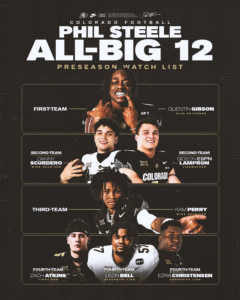
–
—–
June 2nd
ESPN Top 100 Newcomer List includes two Buffs
From ESPN … If the upcoming 2026 college football season is anything like its predecessor, transfer quarterbacks and top freshmen will be crucial for many College Football Playoff runs.
And by now, with less than 100 days until the start of the season, we can assess rosters and what players did during spring practice with their new teams. While we have analyzed the top newcomer for each Power 4 team, these rankings are regardless of teams. They give a more thorough account of which teams have best assessed their rosters and brought in top talent.
Each player is ranked based on a team’s need and what physical skill set they bring to their new team.
5. Jordan Seaton, OT, LSU Tigers
33. Omarion Miller, WR, Arizona State Sun Devils
–
35. Danny Scudero, WR, Colorado Buffaloes
Year: Senior
Pos. rank: 8
Need: After losing three of its top four wide receivers, Colorado had to rebuild the position group under new offensive coordinator Brennan Marion, who comes over from Sacramento State. While Joseph Williams returns after recording 489 receiving yards last season, Scudero gives the Buffaloes another important option in Marion’s Go-Go offense. Deion Sanders praised Scudero’s skill and work ethic throughout spring practice, even comparing him to Julian Edelman.
Value: The coverage will be tighter in the Big12, but Scudero was ultra-productive at San Jose State (88 catches for 1,297 yards) and those intangibles and physical tools have transitioned smoothly in Boulder. He brings explosiveness and quickness that allow him to separate easily from defenders. That separation ability comes from his sharp change of direction and vertical speed. Combined with his natural feel as a route runner and big-play ability, Scudero gives QB Julian Lewis another dynamic option entering his second season.
–
92. Gideon Lampron, LB, Colorado Buffaloes
Year: Senior
Pos. rank: 4
Need: With Jeremiah Brown, Reginald Hughes, Shaun Myers and Martavius French no longer on the roster, Colorado was looking to replace its four linebackers who combined for 184 total tackles last season. Lampron, an All-MAC selection, accounted for 119 total tackles, which was 16th in the FBS last season. Before his time at Bowling Green, Lampron was a first-team FCS All-American at Dayton.
Value: Lampron is an extremely instinctive linebacker who continuously shows up around the ball. He has a very quick trigger and has the short-area quickness to close on the ball carrier in a hurry. His pursuit angles put him in great position to make plays. Lampron also has great quickness to slip blocks.
–
—–
May 31st
Athlon’s Big 12 Predictions: Four teams in Top 25; Ten will be bowl-eligible
From Athlon Sports …
Predicted Order of Finish …
- No. 1 – Texas Tech (No. 12 nationally)
- No. 2 – BYU (No. 16)
- No. 3 – Houston (No. 19)
- No. 4 – Utah (No. 20)
- No. 5 – Kansas State (No. 31)
- No. 6 – Arizona (No. 32)
- No. 7 – Arizona State (No. 35)
- No. 8 – Oklahoma State (No. 36)
- No. 9 – TCU (No. 37)
- No. 10 – West Virginia (No. 50)
- No. 11 – Kansas (No. 52)
- No. 12 – Baylor (No. 62)
- No. 13 – Cincinnati (No. 63)
- No. 14 – Colorado (No. 64)
- No. 15 – UCF (No. 65)
- No. 16 – Iowa State (No. 70)
Big 12 Bowl Projections …
- College Football Playoff – Texas Tech
- Rate – TCU v. Illinois
- Pop-Tarts – Houston v. Louisville
- Texas – Oklahoma State v. Missouri
- Independence – West Virginia v. Kennesaw State
- Alamo – BYU v. USC
- Sun – Utah v. Virginia
- Las Vegas – Arizona v. Iowa
- Armed Forces – Arizona State v. Navy
- Liberty – Kansas State v. Auburn
(Former) Pac-12 bowl related projections …
- College Football Playoff – Oregon
- Alamo – USC v. BYU
- Holiday – Washington v. Clemson
- Sun – Utah v. Virginia
- Las Vegas – Arizona v. Iowa
- Armed Forces – Arizona State v. Navy
- First Responder – Cal v. Washington State
–
—–
May 26th
Ranking of Power Four Coaches: Coach Prime No. 60 out of 68
… Not much love for the Big 12, with nine of 16 head coaches ranked in the bottom 1/3 of the list …
From CBS Sports … It’s late May, which means two things around these parts. One is that the college football season is drawing near. Soon, we will be awash in conference media days and the sounds of pads popping in preseason camp.
The second is that it’s time for the Ball Knowers among CBSSports.com’s college football literati to rank the Power Four coaches. We’ve done this for over a decade, and, as has been the case each time, there is no set criterion for how any of our 10 voters rank the coaches.
You can rank strictly on achievements or potential. Hell, you can rank on who gives the best press conferences or who you think the best dresser is. Sure, the rest of us will probably give you the side eye if you do that and say things about you in the group chat (the one you aren’t in), but we won’t stop you from doing it.
The point is, there are no wrong answers here, at least, not among the group here. I’m sure plenty of you reading this will feel that most of the answers are wrong. That’s OK too. We’re used to it.
From the Big 12 …
- No. 66 – Collin Klein – Kansas State
- No. 65 – Morgan Scalley – Utah
- No. 62 – Scott Frost – UCF
- No. 60 – Deion Sanders – Colorado … Last year, Coach Prime was one of our biggest climbers, going from No. 61 to No. 33. He didn’t finish lower than 43 on any of our ballots. This year, after a 3-9 season, he didn’t finish higher than 52nd on any of our ballots. The 2024 season was special in Boulder, but it’s sandwiched by two 1-8 seasons in conference play. 2025 rank: 33 (-27), High: 52, Low: 63
- No. 59 – Jimmy Rogers – Iowa State
- No. 54 – Rich Rodriguez – West Virginia
- No. 53 – Scott Satterfield – Cincinnati
- No. 47 – Dave Aranda – Baylor
- No. 46 – Eric Morris – Oklahoma State
- No. 41 – Brent Brennan – Arizona
- No. 34 – Lance Leipold – Kansas
- No. 26 – Sonny Dykes – TCU
In the Top 25 … To be published in a separate article … Kenny Dillingham, Arizona State … Joey McGuire, Texas Tech … Willie Fritz, Houston … Kalani Sitake, BYU …
–
—–
May 22nd
Athlon quotes anonymous Big 12 coaches – On CU: “It’s really gonna depend on if they can protect the passer”
From Athlon Sports … It’s not easy getting college football coaches to honestly comment on another coach, player or team. Most coaches don’t want to give opposing teams bulletin board material, which is why there is a great deal of coach speak and overused cliches used during the year.
In order to get an accurate assessment of teams heading into 2026, Athlon asked coaches in the Big 12 to talk anonymously about their opponents.
Colorado
— “They’re interesting because you’ve got a young, hungry offensive coordinator who was a head coach (Brennan Marion), which is great experience. I love the defensive coordinator hire, Chris Marve.”
— “I really like some of their skill players that they have. They’re always gonna have receivers and DBs. That’s just Deion’s deal.”
— “It’s really gonna depend on if they can protect the passer and how good can (Julian Lewis) be in Year 2 while still being a young guy. You just watch them on tape last year, and they didn’t do one thing to help the O-line, help the quarterback to get the ball out to the perimeter or moving the pocket. They get schemed up every week from a protection standpoint. Now, with a new coordinator, you’d hope that would change somewhat.”
–
—–
May 19th
Big Ten Meetings: “Unsustainable” payouts not ending soon – “Does anyone want to be governed?”
From ESPN … Few industries embrace buzzwords the way college athletics does, which is why — with spring sports coming to a close — the impending offseason is destined to be remembered as the moment of alleged “unsustainable” spending.
From Washington athletic director Pat Chun to Michigan State athletic director J Batt to Colorado coach Deion Sanders, “unsustainable” has become the decree of recent months. Heck, everyone from Charles Barkley to Ted Cruz to Nick Saban has dropped the U-word.
The place where unsustainable meets thriving is the Big Ten, which is hosting its spring conference meetings in Southern California this week. The ongoing paradox of college sports — high ratings and loud complaining, $5 million-plus deals for players countered by concerns about how to pay them — met with the conference’s championship realities here.
“What is unsustainable?” Maryland athletic director Jim Smith asked ESPN. “Is it three years? Five years? Ten years? Every time I hear when people say it’s unsustainable, I’m not sure what timeframe they’re talking about because clearly it keeps happening.”
The Big Ten has the most cash flow from TV contracts, and it has also won the past three national titles in football. In April, Michigan won the league’s first men’s basketball title since 2000. UCLA won the women’s basketball title, the league’s first since 1999.
In a not-so-subtle move to show that the league’s titles, perhaps, mean more, the Big Ten displayed its football and men’s and women’s basketball trophies outside the meeting rooms. (As if the coaches and administrators didn’t remember who won).
So two existential questions hover over Big Ten leaders — and college sports as a whole — as they gather in the wake of their collection of glimmering trophies. What will slow the spending spree in college sports? And is it in the best interest of financial heavyweights in the Big Ten and SEC for spending to be capped or curbed?
“When you look at the money that’s being generated,” Michigan basketball coach Dusty May said, “how does it not eventually get to the players in some way, shape or form?”
How much has the spending spiked? Consider the Ohio State 2024 football roster that won the national title famously cost $20 million. At the time, it was branded with the zealous clutching of pearls as an outrageous amount.
Heading into 2026, that’s considered the minimum cost of doing business. Few teams in the 18-team Big Ten aren’t spending $20 million, and those not in that neighborhood are projected in the teens of the conference standings for 2026.
The new frontier for a football roster is flirting with $50 million for a single season. (Men’s basketball rosters are rocketing past $20 million.) And neither the College Sports Commission nor institutional austerity are keeping those football rosters in two years from climbing into the neighborhood of $80 million or $90 million.
“Nothing would surprise me at this point,” Iowa coach Kirk Ferentz told ESPN. “I’m not optimistic either. Based on the last three years. I don’t know how you do enforce it because the rules are so ambiguous. So that’s where the challenge is.”
He added: “One thing I miss about the NFL is a salary cap, and people having contractual obligations.”
What stops the spending? Nebraska coach Matt Rhule joked that he’s the guy with an opinion on everything — except this. “I honestly don’t know. I would say there’s not many times the NFL salary cap’s gone backwards. But I don’t know, honestly. Everything’s so in flux.”
… Continue reading story here …
–
—–
May 15th
Complete overhaul of bowl structures may come as early as 2027
From YahooSports.com … For years, one of college football’s most popular offseason experiments is answering a question that’s lingered since the inception of the four-team playoff: What happens to bowl games?
That conversation has accelerated given the expansion to a 12-team playoff and the likely eventual growth to at least 16 teams.
Do the bowls shift to September as season-opening neutral-site games? Are they all eliminated completely? Are they incorporated into a bigger playoff field?
College football enters its most dramatic offseason in the modern history of bowl games. A revolutionary change to the bowl slate doesn’t feel possible — it feels inevitable. A yearslong conversation is nearing its inflection point.
“The power league guys must decide what they want the postseason to look like,” said one bowl game executive. “Does it include bowls or not?”
The leaders of the power conferences have been exploring proposals to dramatically change the financial structure and selection process of the non-CFP bowl games — at least those tied to the Big 12, SEC, ACC and Big Ten.
In one proposal shared with high-level administrators, a consortium of 10 bowl games — each pitting power conference programs — would be created and potentially sold on the open market, with its television rights controlled by the conferences themselves instead of the bowls. Presumably, these games will be played in existing bowls, but their participants would vary as the bowl system untethers from its traditional conference affiliations.
Could this mean an SEC team in the Alamo or Holiday Bowl? What about a Big 12 team at the Citrus or Gator?
What’s not to like? Five teams from each power league get tossed into a bucket, paired together based on attractive matchups, meet in interesting, new cities and make more cash than they currently generate.
The proposal is in the early stages of socialization among college stakeholders and ESPN — the primary bowl game television partner who has been a part of the proposal itself.
A target for any bowl remake is the 2027 season. This year’s upcoming bowl slate isn’t expected to undergo major changes.
… Continue reading story here …
–
—–
May 13th
CBS Sports 1-138 rankings: Three Big 12 teams in Top 25; CU in at No. 73 (last in the Big 12)
From CBS Sports … Spring practice has wrapped up across the country, and now teams are entering a summer period focused on individual development for the players and the recruiting trail for the coaches. Since we no longer have a spring transfer portal, the rosters are mostly set, so now seems like a good time to check in with our experts to see how they view the college football landscape heading into the 2026 season.
The CBS Sports 138, which has grown this season by two teams with the additions of North Dakota State and Sacramento State, is a comprehensive ranking of every FBS team. Experts from CBS Sports and 247Sports submit ballots weekly during the season, but we haven’t reshuffled the deck since the confetti fell on Indiana’s national championship win against Miami back in January. With a full offseason of player movement and additional information coming out of spring practice, we wanted to know what teams are competing for what spots in the rankings and how the picture has changed since the end of last season.
What our balloting revealed was a wide array of opinions for the No. 1 team in the land and very little consensus on how some of the top six or seven teams stack up against each other. Ohio State is our No. 1 team to start the 2026 rankings cycle of the CBS Sports 138, but the Buckeyes had an average ballot ranking of 2.0 from our experts.
There is some agreement among the top five teams with Ohio State, Texas, Oregon, Notre Dame and Georgia all carrying average ballot rankings of 4.6 or better, but the wide dispersion of votes for the group leaves us with a clear tier of contenders but almost no agreement on the order. Those five teams, plus reigning national champion Indiana and last year’s runner-up Miami (who also got a first-place vote), are the teams our group has collectively found to be the true top tier in the sport.
Top 25 …
| Rank | Team | 2025 Record | Final 2025 Ranking |
|---|---|---|---|
| 1 | Ohio State | 12-2 | 3 |
| 2 | Texas | 10-3 | 13 |
| 3 | Oregon | 13-2 | 5 |
| 4 | Notre Dame | 10-2 | 8 |
| 5 | Georgia | 12-2 | 6 |
| 6 | Indiana | 16-0 | 1 |
| 7 | Miami | 13-3 | 2 |
| 8 | Texas A&M | 11-2 | 9 |
| 9 | Texas Tech | 12-2 | 7 |
| 10 | Oklahoma | 10-3 | 12 |
| 11 | Alabama | 11-4 | 11 |
| 12 | Ole Miss | 13-2 | 4 |
| 13 | LSU | 7-6 | 53 |
| 14 | USC | 9-4 | 16 |
| 15 | BYU | 12-2 | 10 |
| 16 | Michigan | 9-4 | 20 |
| 17 | Tennessee | 8-5 | 32 |
| 18 | Penn State | 7-6 | 46 |
| 19 | Washington | 9-4 | 26 |
| 20 | SMU | 9-4 | 27 |
| 21 | Missouri | 8-5 | 34 |
| 22 | Utah | 11-2 | 14 |
| 23 | Iowa | 9-4 | 21 |
| 24 | Louisville | 9-4 | 35 |
| 25 | Florida | 4-8 | 71 |
From the Big 12 …
- No. 27 – Houston
- No. 29 – Arizona
- No. 30 – Kansas State
- No. 34 – TCU
- No. 39 – Arizona State
- No. 42 – Georgia Tech
- No. 48 – Northwestern
- No. 50 – Baylor
- No. 54 – Iowa State
- No. 55 – Cincinnati
- No. 56 – Kansas
- No. 60 – Oklahoma State
- No. 65 – UCF
- No. 70 – West Virginia
- No. 73 – Colorado
–
—–
May 10th
On3Sports Bowl Projections: Texas Tech in the CFP; 19 Pac-12/Big 12 teams bowl bound (but not CU)
From Brett McMurphy on On3Sports … With the completion of spring practices, there’s never been a better time to release my On3 Post-Spring bowl projections. (Not to be confused with Post Malone’s bowl projections. Mine has fewer tats). Has it really been more than two months since the unveiling of my On3 Way-Too-Early bowl projections for 2026?
Yes, it has.
Since my last projections, four astronauts circled the moon. Back here on Earth, SEC commish Greg Sankey and Big Ten commish Tony Petitti still can’t agree on a future playoff format.
Onto my 2026 Post-Spring College Football Playoff and bowl projections. Godspeed.
College Football Playoffs
First Round (Dec. 18-19)
No. 12 North Dakota State at No. 5 Oregon
No. 9 Texas Tech at No. 8 Texas A&M
No. 11 Penn State at No. 6 Texas
No. 10 Oklahoma at No. 7 Indiana
Quarterfinals
Fiesta Bowl (Dec. 30)
State Farm Stadium in Glendale, Ariz.
No. 3 Notre Dame vs. No. 6 Texas
Cotton Bowl (Jan. 1, 2027)
AT&T Stadium in Arlington, Texas
No. 4 Georgia vs. No. 5 Oregon
Rose Bowl (Jan. 1, 2027)
Rose Bowl Stadium in Pasadena, Calif.
No. 2 Ohio State vs. No. 7 Indiana
Peach Bowl (Jan. 1, 2027)
Mercedes-Benz Stadium in Atlanta
No. 1 Miami vs. No. 8 Texas A&M
Semifinals
Orange Bowl (Jan. 14, 2027)
Hard Rock Stadium in Miami Gardens, Fla.
No. 1 Miami vs. No. 4 Georgia
Sugar Bowl (Jan. 15, 2027)
Caesars Superdome in New Orleans
No. 2 Ohio State vs. No. 3 Notre Dame
National Championship (Jan. 25, 2027)
Allegiant Stadium in Las Vegas
No. 1 Miami vs. No. 3 Notre Dame (Miami winner)
Big 12 and Pac-12 bowl projections (former Pac-12 teams are still aligned with Pac-12 bowls) …
Cure Bowl
Orlando, Fla.
UCF vs. USF
Frisco Bowl
Frisco, Texas
Baylor vs. UTSA
Hawai’i Bowl
Honolulu
Hawaii vs. Arizona State
Rate Bowl
Phoenix
Kansas vs. Wisconsin
Pop-Tarts Bowl
Orlando, Fla.
Louisville vs. Houston
New Mexico Bowl
Albuquerque, N.M.
New Mexico vs. Washington State
Texas Bowl
Houston
Auburn vs. BYU
Birmingham Bowl
Birmingham, Ala.
Missouri vs. Oklahoma State
Independence Bowl
Shreveport, La.
TCU vs. UCLA
Alamo Bowl
San Antonio, Texas
Kansas State vs. Utah
Sun Bowl
El Paso, Texas
Virginia Tech vs. Arizona
Las Vegas Bowl
Las Vegas
USC vs. Michigan
Armed Forces Bowl
Fort Worth, Texas
Cal vs. Memphis
Liberty Bowl
Memphis, Tenn.
Cincinnati vs. South Carolina
Holiday Bowl
San Diego
Pitt vs. Washington
–
—–
May 6th
CBS Post-season picks: Big 12 doesn’t get a CFP bye; Oklahoma State goes from 1-11 to a bowl
From CBS Sports … Now that spring practice is over, we’ve refreshed our College Football Playoff and bowl projections ahead of the 2026 season. With a clearer picture of team rosters, incoming freshmen and how transfers fit within respective depth charts, we have a better sense (at least for now) of how things could look when postseason matchups are decided in early December.
This outlook reflects a sport in transition, where expanded playoff access and increased roster movement continue to fuel parity at the top. In fact, recent postseason trends have already shown a surge in first-time playoff participants, suggesting that unpredictability may again define the national title race in 2026.
Like all post-spring predictions, these serve less as definitive outcomes and more as a baseline for debate — highlighting contenders, potential risers and the ever-present volatility that makes college football’s postseason so compelling. We’re sticking to the six-win minimum threshold for bowl eligibility here, but, like most years, there will likely be a five-win team (or two) needed to fill slots after coaching-change-related invitation declines or not enough programs meeting the entry requirements.
Big 12 and (former Pac-12) bowl projections (former Pac-12 schools still tied to Pac-12 bowls) …
- First Responder Bowl: Cincinnati vs. North Carolina
- Rate Bowl: Kansas State vs. Wisconsin
- Fenway Bowl: Georgia Tech vs. Memphis
- Texas Bowl: Utah vs. South Carolina
- Independence Bowl: Arizona vs. Army
- Sun Bowl: TCU vs. Utah State
- Liberty Bowl: Florida vs. Oklahoma State
- Holiday Bowl: Arizona State vs. Virginia Tech
- Alamo Bowl: BYU vs. Washington
- Las Vegas Bowl: USC vs. Tennessee
- Pop-Tarts Bowl: Houston vs. Louisville
College Football Playoffs …
| Dec. 18, 2026 | Ohio Stadium Columbus, Ohio | (9) LSU at (8) Ohio State | No. 1 seed Miami |
| Dec. 19, 2026 | Jones AT&T Stadium Lubbock, Texas | (10) SMU at (7) Texas Tech | No. 2 seed Texas |
| Dec. 19, 2026 | Memorial Stadium Bloomington, Ind. | (11) Ole Miss at (6) Indiana | No. 3 seed Oregon |
| Dec. 19, 2026 | Sanford Stadium Athens, Ga. | (12) UNLV at (5) Georgia | No. 4 seed Notre Dame |
–
—
ESPN: Ranking the off-season – CU (a surprisingly high) 9th in the Big 12
From ESPN … Ahead of a College Football Playoff semifinal matchup against Oregon, Indiana coach Curt Cignetti took time out of his weekend prep to secure the most impressive transfer group for the 2026 season.
As Miami got ready to face Cignetti’s Hoosiers in the national title game, news broke that the team was set to poach quarterback Darian Mensah from Duke. That all came around the same time that USC was signing the top 2026 recruiting class.
No sport has a blurrier line between its season and its offseason than college football. Even as coaches and teams prepare for the biggest games, they are always focused on what’s next. The alternative is falling behind and perhaps never catching up.
Offseasons matter more than ever, which is why schools are hiring — and paying for — more-accomplished general managers and building out NFL-style personnel departments to support their on-field coaching staffs. Rosters are reshaped almost every offseason as transfer movement hasn’t slowed down and teams replace stars bound for the NFL.
There are other factors shaping the offseason, including full-scale coaching changes and the departures and arrivals of coordinators and other assistants. Continuity still matters in college football, but not at the expense of upgrading certain positions or units. Just look at Indiana’s work after the 2025 season.
Our task is to rank the offseasons among Power 4 teams, prioritizing three areas:
- Roster additions through the portal and the high school ranks
- Retention of top players who could leave for the NFL draft or the portal
- Coaching staff continuity or key additions/upgrades
All three elements go into the overall ranking. Teams that kill it with portal additions but let several star players or coaches walk out the door don’t project as well overall. Similarly, teams that run it back with players and coaches but don’t look to improve clear deficiencies, with on-field ability and scheme, will fall short in these rankings. We’re looking at the total picture.
From the Big 12 …
- Texas Tech
- BYU
- Arizona
- Houston
- Oklahoma State
- TCU
- Arizona State
- Utah
- Colorado
- Key additions: WR Danny Scudero, WR DeAndre Moore Jr., DL Santana Hopper
- Key departures: OT Jordan Seaton, WR Omarion Miller, S Tawfiq Byard
- Top incoming recruits: CB Preston Ashley, WR Alexander Ward, OLB Carson Crawford
Biggest coaching move: Deion Sanders ended up replacing both of his coordinators after a 3-9 season, although defensive coordinator Robert Livingston’s NFL return came late in the cycle. The splashier move came at OC, as Brennan Marion, who led Sacramento State in 2025, has arrived in Boulder to install his “Go-Go” offense. Marion had great success as UNLV’s offensive coordinator, setting a team scoring record (36.2 PPG) in 2024, and his Sacramento State squad averaged nearly 34 points last fall. He takes over a unit that backslid substantially without Shedeur Sanders and Travis Hunter, finishing 114th nationally in scoring. Sanders promoted Chris Marve, the former Vanderbilt defensive coordinator, to replace Livingston.
What went wrong: This was yet another high-attrition offseason for the Buffaloes’ roster, with 35 scholarship players departing via the transfer portal, including 16 who earned starts in 2025. Seaton exiting after two seasons to join LSU was a tough blow, as was Miller moving on to Arizona State. The secondary needed to be rebuilt after starters Byard (Texas A&M), DJ McKinney (Notre Dame), Carter Stoutmire (Arkansas) and eight more scholarship players transferred. Colorado’s promising freshman class also took some big hits with London Merritt (Clemson), Alexander McPherson (Penn State) and Carde Smith (Memphis) departing after one season in Boulder.
What went right: It’s easy to get excited about what Marion is working with in his Julian Lewis-led offense. The Buffaloes reloaded at receiver with Scudero, Moore and Kam Perry coming in to complement Joseph Williams. They inked seven offensive linemen with starting experience to get things fixed up front. There are also a ton of multiyear starters among the 25 portal additions on defense. Hopper and Toby Anene (North Dakota State) are proven veterans on the line and All-MAC performer Gideon Lampron (Bowling Green) and Liona Lefau (Texas) are big upgrades at linebacker. If this staff can bring the best out of Tennessee transfer DB Boo Carter, he’ll be fun to watch alongside Justin Eaglin (James Madison), Randon Fontenette (Vanderbilt) and several more experienced additions in the secondary.
- Kansas State
- Baylor
- UCF
- Kansas
- Cincinnati
- West Virginia
- Iowa State
–
—–
April 29th
CBS Sports Post-spring Top 25: Big 12 Down to Three Ranked Teams
From Brandon Marcello at CBS Sports … Texas Tech is the top story in college football … but not for the reasons the Red Raiders had hoped. The vibes in Lubbock shifted from dark horse national title contender to dark clouds after a gambling scandal likely cost Texas Tech its star quarterback.
Losing Brendan Sorsby, one of the most productive signal-callers in the conference, a player who looked like the difference-maker for Tech after his success at Cincinnati, is the kind of development that makes a reporter reach for the Tylenol and makes a fan base lose sleep.
The news dropped just as I was finalizing my post-spring top 25, leading to a shakeup on my list. Interestingly, the analytics model I built this offseason to power my rankings remained steadfast as a cold-blooded machine. Its weighted formula is designed to strip away the hype, but when I plugged in the post-spring data, the computer didn’t flinch with Tech. Because of the massive scoring gap between the top seven teams and No. 8 in the model, the math kept Texas Tech at No. 7 despite me introducing a few formula tweaks contextualizing the loss of Sorsby’s production.
I, however, have a pulse.
While information is context and context is king, common sense is the palace guard. In my published top 25 today, I applied a human override by manually dropping the Red Raiders four spots from where the formula says they belong. A team doesn’t lose a talent like Sorsby and expect to maintain a top-10 pace in this chaotic era, especially with backup Will Hammond likely to miss the beginning of the season. Tech has a favorable schedule featuring three of its toughest games at home, but will it look the part of a top-eight team without its multi-million-dollar QB? Probably not.
Spring ball is in the rearview mirror, and the waters are getting rough for some and calmer for others ahead of a crucial summer. Let’s dive into the post-spring top 25.
No. 1 – Texas
From the Big 12 …
11. Texas Tech
Texas Tech is the story of the offseason — and for all the wrong reasons. Many don’t expect Brendan Sorsby to be back on campus after he admitted his gambling addiction to Texas Tech officials. The NCAA is unlikely to approve his eligibility. That leaves the otherwise-loaded Red Raiders in a major lurch. Backup QB Will Hammond is not expected to be ready for the season (knee), leaving Joey McGuire with his third option. The good news amid this unforeseen mess? The schedule is so favorable that the Red Raiders will likely remain the favorite to win the Big 12 when preseason camp begins.
17. BYU
Veteran rosters will always do well in this new era, but the loss of the three top receivers from last season could lead to some growing pains. QB Bear Bachmeier returns after a breakout season. Let’s see the Cougars lean more on the tight ends and 12 personnel. The defense saw few changes to the scheme, with Kelly Poppinga now leading the unit.
24. Utah
The offense will be a work in progress with QB Devon Dampier returning under a new OC. In fact, it’s a transition year for the entire program after longtime coach Kyle Whittingham’s surprising departure for Michigan. DC Morgan Scalley steps in after serving as the “coach in waiting” and has made some changes, particularly in how the Utes practice. Can he maintain the physical edge in the trenches that defined the Utes under Whittingham?
–
—–
April 19th
FanDuel: Texas Tech 2nd-most likely to make the CFP (CU: worst odds in the Big 12)
From Fan Duel … Odds to make the College Football Playoff
From the Big 12 …
- Texas Tech … -390 (only Notre Dame has better odds to make the CFP, at -650)
- BYU … +430
- Utah … +500
- Kansas State … +900
- Houston … +1000
- TCU … +1300
- Arizona … +1400
- Baylor … +1500
- Arizona State … +1600
- Kansas … +2000
- Oklahoma State … +2000
- UCF … +2700
- West Virginia … +3000
- Cincinnati … +5000
- Iowa State … +6000
- Colorado … +8000 (only six schools in the Power Four conferences … Syracuse, Maryland, Michigan State, Stanford, Boston College and Purdue have worse odds than does Colorado)
–
—–
April 16th
CBS Sports “bold” prediction: This is Coach Prime’s final season
From CBS Sports … After a long offseason, college football is finally back… sort of. Spring camps are underway, and we’re finally getting our first look at what teams could look like during the 2026 season.
As you can imagine, all the news is good when practices first open. Every team raves about their new quarterback and exciting coaching staff. Players are bigger, stronger and faster than ever before. Hope springs eternal for moribund programs hoping for their moment in the sun.
Unlike last year, rosters should be mostly set. The post-spring transfer window has gone away, meaning that reinforcements are not on the way. Assuming the NCAA’s new rules are observed, coaches are going to have to find a way with what they’ve brought to campus. With a hyperactive transfer cycle and many new faces across the conference, it’s an interesting challenge.
With that said, here are bold predictions for all 16 teams in the Big 12.
Colorado: This is Coach Prime’s final season
Deion Sanders is responsible for the most electric moments at Colorado in the 21st century. He also just posted the second-worst season since 2014, a 3-9 disaster with a 1-8 mark in conference play. This year, the Buffaloes face two Power Four opponents on the road in non-conference play with a roster still featuring many question marks. Coach Prime managed to put his stamp on college football, but there’s not much left to accomplish in Boulder.
… Continue reading story here …
–
—–
April 15th
Five Big 12 teams make ESPN’s Post-Spring Top 25
From ESPN … In college football’s NIL and transfer portal era, there’s no debate the balance of power has shifted from the SEC to the Big Ten.
After SEC teams won four straight national titles from 2019 to 2022, Big Ten teams have won each of the past three: Michigan, Ohio State and Indiana.
The Hoosiers’ perfect 16-0 season in 2025, which culminated with a 27-21 victory against Miami in the College Football National Championship game, might have been the best evidence that once-woebegone programs can change their fortunes with the right coach and budget.
Will the SEC end its “slide” in 2026? Will the Big Ten continue its dominance?
Those two leagues have seven of the top 10 teams in our updated Way-Too-Early Top 25, so it’s a debate that will continue to play out until the final CFP game of January 2027.
These rankings have been updated from the initial rankings, which were published immediately after January’s national championship game, based on player movement, coaching changes and developments this spring.
From the Big 12 …
8. Texas Tech Red Raiders
2025 record: 12-2, 8-1 Big 12
Previous ranking: 7
2026 outlook: After their offense fell flat in the CFP, the Red Raiders spent big to upgrade that side of the ball. Sorsby was one of the top quarterbacks in the transfer portal and is a true dual threat. Running backs Cameron Dickey and J’Koby Williams are returning, and the Red Raiders grabbed a trio of speedy receivers out of the portal. The losses on defense are enormous, starting with Bailey, Hunter and Height up front. Ibirogba was ESPN’s No. 1-rated interior defensive lineman in the portal, and White and Trick were highly ranked on the edge. The Red Raiders will be counting on Romaine to fill in for the irreplaceable Rodriguez.
–
12. BYU Cougars
2025 record: 12-2, 8-1 Big 12
Previous ranking: 11
2026 outlook: The Cougars won 11 games or more for the second straight season. Their biggest victory might have been locking up coach Kalani Sitake, who turned down Penn State to remain at his alma mater. The Cougars have a good core of star players — quarterback Bear Bachmeier and tailback LJ Martin lead the way on offense. Lyons and former Oregon tight end Roger Saleapaga looked ready to help in the spring, along with speedy freshman receiver Legend Glasker. Parker Kingston, the team’s leading receiver in 2025, is no longer with the team after he was arrested in February on felony rape charges. Kelly Poppinga was promoted to defensive coordinator after Jay Hill left for Michigan.
–
18. Utah Utes
2025 record: 11-2, 7-2 Big 12
Previous ranking: 25
2026 outlook: New Utah coach Morgan Scalley was able to persuade quarterback Devon Dampier to run it back after he had 3,325 yards of offense and 34 touchdowns in 2025. Leading rusher Wayshawn Parker also will return. Now, the bad news: Along with losing bookend offensive tackles Fano and Lomu, the Utes lost a boatload of assistants and players who followed former coach Kyle Whittingham to Michigan. Daley, who had 11.5 sacks in 2025, is a big loss on defense, as are Snowden and Lea’ea. Scalley hired Utah State’s Kevin McGiven as offensive coordinator, and linebackers coach Colton Swan was promoted to take charge of the defense.
–
23. TCU Horned Frogs
2025 record: 9-4, 5-4 Big 12
Previous ranking: 20
2026 outlook: After getting the Horned Frogs back on track, coach Sonny Dykes made big changes. He hired former UConn offensive coordinator Gordon Sammis to replace Kendal Briles, who left for South Carolina. The Huskies had a 3,000-yard passer, 1,000-yard receiver and 1,000-yard rusher for the first time in school history in 2025. There will be fewer Air Raid elements and more physicality under Sammis. Hoover transferred to Indiana, and Dykes plucked Craig from the Ivy League to take over. Last season, Craig passed for 2,869 yards with 28 total touchdowns. Replacing McAlister’s production won’t be easy, but Jordan Dwyer is back and will be the No. 1 receiver.
–
24. Houston Cougars
2025 record: 10-3, 6-3 Big 12
Previous ranking: NR
2026 outlook: Willie Fritz wins everywhere he coaches, and the Big 12 should be on notice after a 10-win surge in his second season at Houston. The team returns quarterback Conner Weigman, who had 25 touchdown passes and a 65.9% completion rate last fall, and top wide receiver Amare Thomas. Koziol certainly will be missed and Houston has some holes to fill on the defensive line, but the core of the 2025 team comes back, and Fritz added several transfers with ties to his last team, Tulane, in Hurst, White and Hughes, who rushed for 2,778 yards in two seasons with the Green Wave before his workload vanished at Oregon last fall. If the lineman transfers click, Houston could push Texas Tech and others in the Big 12 race.
–
—–
April 13th
CBS Sports: Is CU’s lineup undersized? Perhaps not, but CU still faces an uphill climb to a bowl game
From CBS Sports … Over the weekend, videos of Colorado’s roster running out of the tunnel went viral. Many pointed to the size of the Buffs’ roster as a concern, saying that they looked undersized for a major conference team.
Quickly, offensive coordinator Brennan Marion took to social media to defend the group.
“We will be just fine…” Marion posted on X. “Just click bait anything to attack Prime. I’m here we good!”
An analysis of the roster shows that size doesn’t appear to be a major issue for the Buffaloes. Colorado’s projected offensive line sits at an average of 6-foot-4.6 inches tall and 321 pounds. Only one of their starters sits below 310 pounds, and it’s Georgia transfer Bo Hughley, who started two games for the Bulldogs.
The defensive line tells a slightly more complicated story. The group sits at an average of 263.8 pounds, which is a little light. Projected starter Santana Hopper is only 265 pounds. However, he arrives at Colorado after ranking among the best interior defensive linemen in the American while with Tulane, and is known for his activity and functional strength inside.
Additionally, Colorado has bigger players on the roster. Hulking Baylor transfer Samu Taumanupepe sits at a cool 375 pounds. Maryland transfer Sedrick Smith is 320. If the Buffaloes want to get more size on the field, they have the opportunity.
Size shouldn’t be the main concern for the offensive line. It’s chemistry.
Colorado has flipped out offensive lines nearly every year, something only exacerbated two years ago when Sanders threw his existing players under the bus and said he had to get new linemen. However, instability along the offensive line is a major issue for building consistent units.
Colorado has tried the portal-shuffling method plenty of times with poor results. Before left tackle Jordan Seaton transferred, the Buffaloes were set to return three starters. Even so, left guard Yahya Attia and right tackle Larry Johnson III give the unit building blocks. Offensive line coach Gunner White is also the first returner at the position under Coach Prime. If he can get the unit to average, it opens up the offense dramatically.
Little margin for error
The day Sanders walked into the Colorado football facility, he told the existing roster that he was bringing his own Louis Vuitton baggage. Outside of college superstars Travis Hunter, Shedeur Sanders and Jordan Seaton (since transferred to LSU), most of it has proven defective.
Thirty-six players transferred out of the program, with 20 landing at Power Four schools. More than 60 newcomers are expected to enter the program.
The level of talent coming is high as the Buffaloes have a top-25 transfer class, fourth-best in the Big 12. Linebacker Liona Lefau (Texas), defensive back Boo Carter (Tennessee) and Moore (Texas) are all potential all-conference selections. Perhaps a returning offensive line coach can bring some much-needed consistency to the Buffaloes’ most troubled unit.
But heading into Year 4, Colorado still faces many of the same issues. The lack of high school recruiting means that only two projected starters were recruited by the staff out of high school: Lewis and Attia. Typically, Years 3 and 4 would be the moments when the staff’s identification and development start paying off.
The schedule also provides few moments of respite. Colorado plays road games against Georgia Tech and Northwestern in non-conference play. Home games against Texas Tech and Utah bode poorly. Depending on Kansas State’s success under first-year coach Collin Klein, the Buffaloes could be underdogs in every FBS game until the season finale against UCF.
Coach Prime helped the Buffaloes overcome daunting odds to reach a nine-win season in 2024. But unless he has another rabbit to pull out of his hat, Colorado has a difficult path back to bowl eligibility.
–
—–
16 Replies to “Preseason Magazines”
The preseason polls remind me of the line from Casablanca when Louie tells Major Strasser that the usual suspects have been rounded up. However Okie State getting votes is an absolute absurdity.
Kickoffs can’t come soon enough
The On3 article is one of the few I’ve seen that actually give Deion some grace for last year in consideration of his cancer battle. And it does mention JuJu as a national talent but then goes on to say there are no other national talents on the roster. Maybe the author rectified that by mentioning top players from the portal such as Scudero, Moore, Lefau, Lampron, etc. Or mentioned the exciting GoGo offense from proven OC Marion? I doubt it, but I’ll never know because the rest of the article is behind a paywall. Bottom line, none of the preseason garbage predictions mean anything. As always it must be proven on the field.
Stuart, have you seen anyone do an analysis of how pre-season forecasting has changed in the NIL/Transfer Portal era versus the “old school” rules era? I would think that the portal has made prognostication somewhat harder.
It’s definitely more difficult, with roster turnover making up half of the lineup even for the best teams.
A telling factoid … Two years ago, Arizona State was picked to finish last by the Big 12 media, and went to the CFP.
Last year (and again this week), there were no preseason polls of media or coaches at the Big 12 media days. No one wants to be responsible for silly guesses in July.
I’m working on a preseason essay for Sunday, and just learning that UCF will be depending on the quarterback from James Madison, who played against Oregon in the CFP last fall. Will Barnett be a savior? Or not able to handle the move to the Power Four? No one knows.
What I read in Sorsby today
Read the TT AD’s statement on ESPN and try not to vomit
basically he is saying this poor little 22 year old’s rehab is more important the corruption of college football
Next up is mr fix it college football Cody Campbell saying TT is the victim of a broken system that he claims he wants to fix but says TT has to carry on by supporting Sorsby before it is fixed….by making it worse?
s’cuse me while I vomit
I hate the entire state of texas now, instead of just baylor, more than the cobbs
Protect the passer?
Duh
as long as we are talking the athletic there are a few sports writers I whole heartedly agree with.
https://www.nytimes.com/athletic/7277707/2026/05/14/college-football-playoff-expansion-24-team/
The Athletic has an aticle on Prime wanting to talk to the new Brown’s coach about what motivates Shedeur. Just about all haters in the comment section but a couple got it right. “not a good look” and “he has had almost 20 years to have that conversation with Shedeur (paraphrased)
sheeesh
You can rank and rank this time if year, and these pundolts will, until the only rank thing is their odor. The only thing I find interesting about this methane expulsion is Iowa State a lot closer to where most people think they should be. Rogers has some cred as a coach but as a head coach its kind of thin. He arrives at I State with an empty pantry and brings with him what seems like half the roster from a 6-6 team without the toughest schedule. They got ground into dust by North Texas which might be anither reason for some optimism over Okie St. but I digress.
The Buff’s? I willbe happy if we didnt see anything at all pertinent in the spring game about Marion’s offense and it turns out to be good enough to get us to a bowl. I buy a lottery ticket now and then so I guess is there is a dumb and dumber chance they could be the next Indiana.
Yeah, taking CU aside, these things are a joke, five reasons:
1. Most rankings provide no methodology or method to their madness; so what are they ranking?
2. Looking at the chart there is no way LSU was the #53 team last year even with Brian Kelly; Florida was not 71, but a 4-8 team does not go to 25th just due to a new coach; Tenn does not magically go from 32 to 17 without any real P-4 experience at QB. Staub could be starting there!
3. All the media is hyped on USC. When you look at https://www.puntandrally.com/teamroster.php?team=USC, they are younger, worse and have less depth at every position group except QB and RB (RB is only good if Waymond Jordan gets healthy). Patterson is completely rebuilding their D. If Maivia is bad or gets hurt, their backup had 7 plays last year. Their TE room is comparable to CU, unless they are counting on True Freshman Bowman. A TE room comparable to CU is tough to accomplish. When was the last time a True Frosh laden team was sniffing the top-10?
4. Much of this is tied to the TV networks; East-coast bias and conferences. Same with the AP, ESPN, and the Coaches Poll to a lesser degree. If certain teams start ranked too low, the chances of getting into the Top-25 are slimmer. If a team starts out ranked high, they can lose a few games and not slip off the map. The big networks cannot let that happen as they will never bank on using low ranked teams for some better national telecast times. I’m sure the country is so excited to see Corn at the 10am MST slot–they are so well played games.
5. With all the transfer turnover on most every roster plus huge coaching turnover, they cannot predict whose roster will gel and whose will not. Plus, poor QB play alone or key injuries can tank just about any season these days.
They should go with a conservative Top-25 and end it at that. The rest are outside the top-25 and teams will jump based on wins and losses not media pundits.
ESPN, after predicting the draft for the last month spent the last few days analyzing the draft and predicting the draft winners and losers. Today the headline is predicting the 2027 draft.
It just might kill these slackers to do a little more research and find something to talk about that matters and makes sense…….or are they really giving mouth breathing sports fans what they want?
If Marion has success, at least the successor is already here.
Well it is obvious that when these writers (I use that term tongue in cheek, more like lazy hacks) they go after Prime. If these writers had been through all that he has been through they would have given up. While I am not sold on his coaching and hiring decisions in the past (they have gotten much better) this time around. His never give up attitude is to to be commended. Just follow the Coach Mac road map and hire great assistants. How many of his coaches got HC gigs, five or six at least? Learn from the past and don’t make the same mistake twice.
Wow
that was nothing but a hit piece. Trolling by morons.
I read all the team blurbs down to the Buffs. All mentioned the players brought in, current players they think wil limprove,,,,bla bla bla
Then on the Buffs…Sanders is done and thats that. No mention of the new OC, Scudero, Lewis or anything.
Why cant these writers, a term they dont deserve, do something productive during the off seasonlike pick up trash along the highways? Otherwise all they are going to do is produce trash for the next 4 months on banal predictions, rankings and other horseshit.
Talk about throwing $hit against the wall to see if it will stick. Coach Prime’s last year because there’s nothing left to accomplish at CU? That takes the cake for the dumbest all time idiotic uninformed prediction!!
Fuck em up. Fuck em up. Go CU!
Go Buffs